
Digital Transformation Trends Shaping Businesses in 2026

Digital transformation means using technology to improve how a business runs and serves customers. That can sound broad, but the best changes are usually simple: faster decisions, fewer handoffs, cleaner data, and better service. In 2026, the most important Digital Transformation Trends share a theme. Tech is no longer a side project owned by IT. It is becoming part of daily work for every team, from sales to finance to operations. This post breaks down the trends shaping real companies right now, what each one means, where it shows up, and how to act without getting overwhelmed. By the end, you’ll know what to prioritize this year and what can wait. AI is becoming the new operating system for business AI is moving from experiments to an everyday work layer. Instead of asking, “Where can we add a tool?”, leaders now ask, “Which decisions and workflows should run with AI support?” That shift changes how teams plan, serve customers, and manage operations. Support reps get faster answers. Planners react to demand changes sooner. Sales teams write better outreach in less time. Supply chains adjust before small issues turn into missed deliveries. Costs also keep changing. Recent reporting shows the cost of AI “tokens” has dropped about 280-fold in two years. At the same time, heavy usage can still create monthly bills in the tens of millions for large firms. So the winners treat AI like any other operating system choice: measure value, control spend, and standardize how teams use it. One caution matters: a widely cited Gartner view is that only about 1 in 50 AI investments becomes truly transformational. The difference is not the model, it is the operating design around it. AI works best as a co-worker with guardrails, not an autopilot with blind trust. From chatbots to copilots, AI is showing up in everyday workflows The biggest change is how normal AI feels at work. Many teams now use copilots to draft emails and proposals, summarize meetings, build first-pass reports, or answer internal questions like “What is our refund policy?” Customer support also uses AI to suggest replies and route tickets faster. These wins add up because they reduce tiny delays all day. However, speed without rules can backfire. AI can sound confident while being wrong, and that can create risk in customer messages, pricing, or legal terms. Strong teams set clear boundaries early. They define which tasks AI can do alone, which need approval, and which need a human review every time. They also track the same basics they track for people: quality, response time, and rework. In practice, that means a simple workflow: AI drafts, a person checks, and the system learns from corrections. When leaders treat AI as part of the process, value grows without chaos. Personalization is moving from “nice to have” to a growth requirement Personalization used to mean adding a first name to an email. In 2026, customers expect relevance across the whole journey: the website, the app, the store, and support. AI-driven personalization connects signals like browsing behavior, purchase history, location, and service interactions. Then it chooses the next best message or offer, based on what a person is likely to do next. “Hyper-personal” is just the right message, at the right time, for the right reason. The payoff shows up in three places. First, conversion rates rise because offers fit real intent. Second, retention improves because customers feel understood, not targeted. Third, marketing waste drops because fewer ads and promotions go to the wrong audience. Still, personalization fails when data gets messy or teams over-automate tone. The best programs keep it simple. Start with a few high-impact moments, like onboarding, replenishment, or save offers. Then test, learn, and expand to other channels. Cloud and hybrid platforms are powering faster change with less lock-in Cloud still matters in 2026, but the real shift is how businesses mix environments. Many now run a hybrid setup: public cloud for speed, private cloud or on-prem for sensitive workloads, and edge computing for real-time decisions near devices. This approach helps in two ways. It lowers lock-in because systems can move as needs change. It also makes AI and data easier to scale without forcing every workload into one place. Industry cloud platforms are part of this story too. Recent forecasts suggest more than 50% of enterprises will use industry cloud platforms by 2027. The appeal is practical: built-in patterns for healthcare, finance, retail, and manufacturing, plus faster time to launch new services. Before choosing a direction, it helps to compare where each environment fits best. Platform choice Best for Common business example Public cloud Elastic demand, fast launches Retail traffic spikes during promotions Private cloud or on-prem Regulated data, tight control Financial reporting and audit needs Edge computing Real-time actions near devices Warehouse automation and safety alerts The takeaway is simple: hybrid is less about tech fashion, and more about matching risk, cost, and speed. Hybrid cloud is the practical choice for scale, speed, and sensitive data Public cloud shines when demand changes fast. If your workloads spike, elasticity saves money and avoids outages. Marketing campaigns, customer portals, and analytics are common fits because teams can scale up and down without buying hardware. On the other hand, private cloud or on-prem setups often win for regulated data, strict latency needs, or local residency rules. Many firms keep parts of finance, identity, and sensitive customer data closer to home, even while they modernize the apps around it. Most businesses end up mixing both. For example, a retailer might run its e-commerce front end in public cloud, while keeping payment processing systems under tighter control. A bank might build AI assistants in a cloud environment, but restrict which data the assistant can access. The goal is not “cloud-first” slogans. The goal is faster delivery with clear boundaries and predictable costs. Edge computing brings real-time decisions closer to where work happens Edge computing means processing data near devices instead of sending it far away to a
Web3 Security Risks in 2026, Top Scams and a Simple Wallet Protection Plan

Web3 doesn’t work like a bank. There are no chargebacks, no fraud desk, and one bad signature can drain a wallet in seconds. That’s the trade-off for self-custody and instant settlement. In 2026, the biggest Web3 Security Risks still come down to the same core threats, phishing and fake support scams, wallet drainers hidden in “mint” links, smart contract bugs, bridge attacks, and plain private key theft. Some are technical, most target people, especially when you’re moving fast or multitasking. Here’s the reality check. Tracking differs by source, but 2025 losses across hacks and scams were widely reported in the $2.7 billion to $4.0 billion range, with several reports pointing near $3.3 billion. There isn’t a reliable total for early 2026 yet, but major incidents and ongoing social engineering show the pressure hasn’t eased. This guide breaks down the most common risks, how they work, and a simple protection plan you can follow day to day. It’s written for everyday users and small teams that need practical habits, not panic. This article is for education only and isn’t financial advice. The biggest Web3 security risks today, and how the scams really work Most real-world Web3 Security Risks don’t start with some genius hacker breaking math. They start with you being nudged into one “small” action, clicking a link, connecting your wallet, or approving a token. Scammers win by blending into the normal flow of crypto, airdrops, mints, support chats, and “security updates” that feel routine. The good news is that the mechanics repeat. Once you understand how the traps work, you can spot them fast and avoid the few actions that cause permanent loss. Phishing, fake support, and AI powered impersonation Phishing in Web3 is less about stealing your password and more about steering you to a fake page that gets you to sign something. Common entry points are everywhere: AI makes this worse because the scams now sound and look professional. Attackers use AI to write support messages in perfect English, generate “proof” screenshots of transactions, and even clone voices for short calls. Chainalysis has flagged how impersonation scams and AI enablement are accelerating in crypto crime trends (see the Chainalysis 2026 scams report). A quick example: you search “ProjectName airdrop,” click an ad, connect your wallet, and a page tells you to “verify” to fix an error. The site isn’t trying to log in as you, it’s trying to make you approve a drain. Here’s a simple red-flag checklist that catches most of these: Wallet drainers and dangerous token approvals (the silent permission problem) Wallet drainers usually don’t “hack” your wallet. They trick you into giving permission. Think of token approvals as a spending permission slip: you’re telling a smart contract it can move your tokens later. The trap is unlimited approval. Many apps ask for it to reduce future clicks. A drainer uses that same convenience against you. Once approved, the attacker can pull funds quickly, often in multiple transactions, without needing your seed phrase. It helps to know the three common actions your wallet asks you to sign: Many drainers trigger right after you connect a wallet and approve. You think you’re approving a “claim contract,” but you are really granting permission to a contract the attacker controls. Seconds later, tokens leave your wallet in the background. If the site also prompts a second signature, that can be the actual transfer. Fastest way to spot it: if a “free claim” asks for an approval before you even see what you’re getting, treat it as hostile. Smart contract bugs and risky forks (when the code is the attacker’s opening) Sometimes the attacker doesn’t need you to click anything. The weakness is in the contract code. Smart contract bugs are like leaving a door unlocked, not because you forgot, but because the lock was built wrong. The most common failure types are simple: A recent pattern is “zombie” contracts, older or unmaintained deployments that still hold value, then get hit when someone notices an old flaw. For example, BlockSec documented an integer overflow style issue in a legacy-style contract setup that contributed to major losses in early 2026 incident reporting (see BlockSec’s January 2026 incident notes). Audits help because they catch obvious mistakes and bad patterns. They do not guarantee safety because code changes, integrations change, admins can misconfigure upgrades, and attackers keep finding new angles. Treat “audited” as a positive signal, not a safety shield. Cross chain bridges and DeFi attacks that move fast and spread far Bridges are high-value targets because they often hold large pooled funds, use complex verification logic, and depend on key management or validator sets that can fail in one bad moment. When a bridge breaks, it can hit more than one chain at once, with wrapped assets losing backing and causing downstream chaos. Historically, bridge losses have reached the multi-billion range across the sector, which is why attackers keep coming back. DeFi attacks also move fast because transactions settle quickly and bots compete to extract value. Three terms you’ll see a lot: The common theme is speed. By the time a team posts “don’t interact,” the money has often moved, been swapped, bridged, and split. Your best defense is simple: be cautious with bridges you don’t need, and treat sudden “high APY” DeFi prompts as a sign to slow down and verify. Lock down your wallet first, the non negotiable habits that prevent most losses Most Web3 Security Risks don’t need a zero-day exploit. They need you to make one “normal” move, connect, approve, sign, or paste an address while you’re distracted. The goal here is simple: limit your blast radius. If one wallet gets clipped by a drainer or a bad approval, it shouldn’t be able to take your whole stack. Think of wallet security like fire doors in a building. You can’t stop every spark, but you can stop the whole place from burning down. Use the right wallet setup for the job (hot wallet, cold wallet, hardware
Service As A Software: How AI Redefines Business?
Professional expertise is now just a click away, faster, smarter, and more affordable than ever. This shift has redefined SaaS not just Software as a Service, but Service as a Software. In this blog, we will learn what is Service as a Software and How AI can Redefine Business? Need For Service as a Software – Traditional SaaS Challenges It’s been years that businesses depend on traditional Software as a Service to make operations efficient but there is a gap that remains. Saas that businesses use still require human expertise to operate. From marketing campaigns to analyzing financial data and optimizing supply chains, businesses need skilled professionals to drive results and make informed decisions. It opens up many challenges for businesses like: How Service as a Software (SaaS 2.0) Solves These Challenges Saas 2.0 or Service as a Software represents the new era of AI based digital transformation for businesses. It offers autonomous, intelligent and scalable solutions to replace manual efforts of humans and decision making. Traditional Software as a Service which provides cloud-based tools always requires user input. In contrast, Saas 2.0 functions as an expert system as it has underlying technologies like AI and machine learning to complete all tasks independently. If businesses adopt Service as a Software, industries can achieve: Industry-Specific Benefits of Service as a Software Boxed software can be according to basic business needs but it sometimes falls short in addressing the unique challenges of specific industries. Industry-specific service as a software offers greater customization, efficiency, and support, helping businesses streamline operations and gain a competitive edge. Below are the key benefits for dealers looking to maximize their software investment. Finance & Banking: Conventionally financial analysis and risk assessments were only done by teams of experts but it was prone to delays and high operational costs. But, AI integration in fintech platforms can provide real-time credit scoring, fraud detection, and automated investment advisory without human intervention. On the other hand, banks and hedge funds must integrate AI-powered risk assessment and algorithmic trading to stay competitive. Healthcare & Pharma: In the healthcare industry and pharma, there is limited scalability as the tasks like medical diagnostics, drug discovery, and patient management have to be dependent on highly skilled professionals. The challenges can be solved by automated diagnostic software. It can help detect diseases from imaging scans, predict patient deterioration, and suggest treatment plans faster than doctors. That’s why hospitals and pharmaceutical companies should pay attention and decide to integrate service as a software like AI predictive analytics and RPA (Robotic Process Automation). It will not only improve patient care but also help with drug discovery. Legal & Compliance: The major problems of compliance sectors are manually done tasks like legal research, contract analysis, and compliance audits. These tasks are time-intensive and require costly legal professionals. But the solution lies in AI-based legal platforms that can draft contracts, conduct due diligence, and monitor regulatory compliance instantly. This is why, law firms and corporate legal teams should adopt AI-powered contract lifecycle management to reduce costs and improve efficiency. Marketing & Advertising: Marketing and advertising companies traditionally rely on manual A/B testing when running ad campaigns. It is just a guesswork which can lead to suboptimal performance. AI in marketing and advertising can help predict real-time consumer behaviour tracking and content creation that in result will maximize ROI. Brands and agencies can transition their business to clients by implementing AI driven marketing automation for hyper-personalized customer engagement. E-commerce & Retail: Inventory management, pricing optimization, and customer personalization require vast human resources. AI in ecommerce and in retail can automate demand forecasting, dynamic pricing, and chatbot-based customer service. It will also enhance sales performance. Retailers must integrate service as a software with AI-powered recommendation engines and automated logistics for seamless scalability. Manufacturing & Supply Chain: The major drawback that supply chain and manufacturing industry face is inefficiency with inventory management, demand prediction and logistics. AI in the supply chain can track real-time inventory with predictive maintenance and route optimization in logistics. However, if manufacturing industries and supply chain companies get AI based predictive analytics in service as a software, they can automate and minimize disruptions to enhance overall productivity. Why Businesses Need to Implement Service as a Software Now! It’s now or never. Because the transition from Software as a Service to Service as a Software is a necessity to remain competitive in an era where automation, efficiency, and scalability define success. There are successful examples like salesforce, slack, mailchimp and zoom. Seeing them, businesses must invest in AI-powered SaaS solutions to: Transform Your Business with AI-Powered Service as a Software OptimusFox is a web3 development company providing AI development services to transform companies worldwide. Our team is expert in AI app development, mobile solutions, and robotic process automation (RPA). We strive to help businesses move beyond traditional SaaS by integrating intelligent automation solutions like service as a software and white label software solutions that scales effortlessly. No matter, if you are looking to streamline your enterprise operations or to enhance your customer engagement or automate complex workflows in an organization, our cutting-edge solutions will help you to reduce costs, boost efficiency, and drive growth. Wrapping Up It is evident that AI is now the consultant, designer, and researcher and it can automate almost every task that once required human effort. Additionally, it does not eliminate the whole human intervention but human AI collaboration can make a transition. As you know, traditional SaaS offered cloud-based software on demand; now, AI is taking it further, delivering professional services as intelligent, automated solutions available anytime, anywhere. This means, Service as a Software (SaaS 2.0) doesn’t just offer tools but it also assists companies with AI-driven solutions to act as the expert, making decisions, analyzing data, and delivering real-time solutions without human intervention. Additionally, industries that delay adoption risk falling behind as AI-driven SaaS solutions become the standard for efficiency, innovation, and profitability. The question is no longer if AI will take over professional
List of 10 Top Blockchain Development Companies of 2025

Blockchain technology disrupted many industries over the past decade. It has redefined how we approach digital trust, transparency, and decentralization. The global blockchain market is expected to reach $39B by 2025, reported by FinanceMagnates. This report shows that it is not a blip but a future innovation. Many companies have already invested in blockchain projects and some have incorporated blockchain into their existing products and processes. From healthcare to education and finance, blockchain brings decentralization to every sector. But, with so many players in the market, finding the right blockchain development partner, such as Top Blockchain Development Companies, can feel like searching for a needle in a haystack. In this article, we have compiled a list for you to explore 10 top blockchain development companies of 2025 and their contribution to blockchain development. Criteria to Shortlist Top Blockchain Development Companies Selecting the best and top blockchain development companies is not easy. That is why, we have set a criteria to evaluate some of the best ones. Below are some of the factors that will be helpful for us to identify the most capable blockchain development firms: Top 10 Blockchain Development Companies of 2025 Blockchain is a necessity these days and businesses constantly look for best blockchain development partners. In the evolving landscape, it is not an easy task. Check the list of top blockchain development companies and explore each company evaluated on the basis of their expertise, portfolio, innovation, client reviews, team size, industry recognition, pricing, and support services. 1. OptimusFox OptimusFox is a leading web3 and blockchain development company that is focused on solving bigger industrial problems using nascent technologies. They help businesses integrate cutting-edge technologies for productivity and growth. Their team excels in implementing innovative strategies and platforms like hyperledger blockchain development to establish a strong presence of any business in the digital landscape. Moreover, they hear the project details first, you can set up a meeting with them by just filling up the contact form and the team will then evaluate your problem and identify your use case and propose you with a solution that is scalable and take your business to the next level. Their Expertise: OptimusFox distinguishes itself as a top blockchain development company as they provide comprehensive Web3 and blockchain development services, AI solutions, and other professional digital services. Whether for startups or large enterprises, they offer expertise in custom blockchain solutions, NFT marketplace development, metaverse applications, smart contracts, and more. Other Information: 2. IBM Blockchain IBM Blockchain is an enterprise blockchain solutions provider. They are an industry leader as they integrate secure, scalable, and efficient distributed ledger technologies in businesses. With 10 years in the industry, they have developed industry-leading blockchain applications that power supply chains, finance, healthcare, and beyond. Their Expertise: IBM specializes in Hyperledger Fabric-based solutions, permissioned blockchain networks, and integration with cloud and AI-powered applications. Their blockchain offerings cater to businesses looking for enterprise-grade solutions backed by IBM’s robust infrastructure. Other Information: 3. ConsenSys ConsenSys is a top blockchain service provider, excels in Ethereum. They offer solutions to enterprises and developers. Their major focus is creating decentralized applications (dApps), Web3 solutions, and blockchain infrastructure to power the next generation of digital economies. Their Expertise: ConsenSys is the creator behind MetaMask, Infura and Truffle. They provide Ethereum-based blockchain services, smart contract development, DeFi solutions, and enterprise-grade Web3 applications. Other Information: 4. Ripple Ripple is a blockchain development company related to the Finance industry. It is known for revolutionizing cross-border payments through blockchain technology. Their flagship product, RippleNet, allows financial institutions to conduct fast, secure, and low-cost transactions globally. Ripple is also the company behind XRP, a digital asset optimized for payments. Their Expertise: Ripple specializes in blockchain-powered financial services, particularly in payment processing, liquidity solutions, and cross-border remittances. Their technology is designed for banks, payment providers, and digital asset exchanges. Other Information: 5. Accenture Accenture is a global consulting and technology powerhouse. They are a top blockchain company as they deliver cutting-edge blockchain solutions to enterprises worldwide. With its deep industry knowledge and strong technology partnerships, Accenture provides end-to-end blockchain consulting and development services. Their Expertise: Accenture focuses on blockchain strategy, supply chain solutions, identity verification systems, and enterprise-grade blockchain integration. They work with platforms like Hyperledger, Ethereum, and Corda. Other Information: 6. LeewayHertz LeewayHertz is a best blockchain development company that specializes in building enterprise-grade decentralized applications. With a focus on innovation, they provide scalable blockchain solutions tailored to business needs. Their Expertise: LeewayHertz offers development on Ethereum, Hyperledger, Stellar, and Tezos, specializing in blockchain consulting, smart contracts, and enterprise solutions. Other Information: 7. Blockchainx BlockchainX is a leading company, founded in 2017, that specializes in providing blockchain and cryptocurrency development services. We deliver excellent services that give businesses a competitive edge & help clients grow by taking a unique approach & focusing on quality. Their Expertise: Our blockchainX team brings strong project management skills as well as a track record of successful projects in this emerging industry. Other Information: 8. 10 Pearls 10Pearls is a custom blockchain development company that helps companies set up Blockchain networks for their business and create secure decentralized databases to help store data, manage supply chains, handle transactions, or any other business needs that Blockchain can solve without jeopardizing privacy. Their Expertise: They offer development on Ethereum, Hyperledger, Stellar, Ripple, IPFS and Tezos, specializing in smart contracts, and enterprise solutions. Other Information: 9. SoluLab SoluLab is one of the top blockchain development companies that has experienced blockchain developers in the US for building Blockchain Games, Ethereum Token, Web 3.0, and Defi. Their Expertise: Solulab is a popular name in blockchain app development and protocol development, dApps development, blockchain-powered Metaverse apps, etc. Other Information: 10. PixelPlex PixelPlex is a blockchain development firm that has been in the game since 2013. They have been helping corporations and startups alike maximize their efficiency via blockchain technologies. Our extensive DLT expertise enables us to create complete and secure digital solutions that generate revenue and meet your business
Kimi AI: China’s Another AI Drop To Redefine AI Reasoning
China is advancing AI at a breakneck pace. After Deepseek r1 headlines, another company named Moonshoot AI dropped Kimi AI 1.5. It is a model that is routing superior to Open AI GPT-4o and DeepSeek AI r1 model. The best part of Kimi AI is that it shows advancements in multimodal reasoning, long-context understanding, and real-time data processing, raising questions about the future of AI dominance. For the record, there’s a long-standing cliché: the U.S. innovates, China replicates, and Europe regulates. But we’re not here to dwell on geographic stereotypes. Instead, we’re looking beyond them to assess how Kimi AI k1.5 is disrupting the AI industry and what its rise means for the future of artificial intelligence: The Startup Behind Kimi AI – Moonshot AI Moonshot AI was founded in 2023 by the youngest CEO Yang Zhilin and is now one of the top AI companies. The company may be new but its rapid growth in AI is remarkable. According to stats, the company secured major funding from Alibaba, Tencent, and other investors, raising its valuation to $3 billion in just one year. What Is Kimi AI? Kimi AI is introduced by a company named Moonshot AI which is a Beijing-based startup. Kimi AI is a large language model (LLM) that understands and generates human-like text responses, particularly in Chinese. Amazingly, this AI tool can handle up to 2 million Chinese characters in a single prompt. It is a highly effective model to analyze lengthy documents and handle complex tasks. Moreover, Moonshot AI is positioning Kimi as a cost-effective yet powerful alternative to the frontier models. It can surpass models in performance like OpenAI’s GPT-4 and DeepSeek’s latest iterations. How Is It Different From Other Frontier AI Models? OpenAI is designed to solve complex problems by breaking them into small pieces. But Kimi k1.5 is better at handling math and coding problems while working with multiple types of data such as text, images and videos. It is setting new records in multiple areas like in advanced reasoning it scored 77.5% which means its surpassing other models. In complex mathematical problem solving it achieved an impressive 96.2 which is exceptional accuracy. Moreover, in visual understanding tests it scored 74.9% which means it has advanced abilities to process images and graphics. This means, Kimi k1.5 is faster and more versatile than any other. It can handle a variety of tasks, like math, coding, and processing text, images, and videos, more efficiently. Unlike DeepSeek-R1, which mainly focuses on text, Kimi k1.5 is more powerful and flexible. Moreover, there is another important fact that Kimi k1.5 costs less to develop than similar AI models in the U.S. The creators of Kimi believe it can compete directly with OpenAI’s O1, and its strong test results support this claim. What Sets Kimi AI 1.5 Apart? Kimi AI is not less than GPT like models. It has advanced AI model capabilities that are pushing the boundaries of reasoning, multimodal intelligence and real time data retrieval. Let’s see some of the features that sets Kimi from the competition in AI industry: Extended Context Memory: Kimi AI can handle 128k tokens at once. It makes it an ideal AI model for processing long-form documents and conversations without losing context. Existing models struggle with memory limitations so when you work with extensive research papers, tech documentations and in-depth research, Kimi AI k1.5 can be your go-to to get continuity and accuracy. Free and Unlimited Access: Existing AI tools come with subscription fees but Kimi AI is free and provides unlimited access to users which makes it an attractive option for users. However businesses and AI enthusiasts can use Kimi AI without any upfront costs. Real-Time Web Browsing: AI models rely on pre-trained data but Kimi AI 1.5 features real-time web browsing capabilities. It has the capability to scan over 1,000 websites instantly. It can pull up-to-date information to provide more accurate and relevant responses. Means that its prowess in financial analysis is already demonstrated by users. Kimi can assess stock trends and news in real time and this is something GPT-4 and DeepSeek currently struggle with. Multimodal Reasoning: Kimi is not text-based only but it can process multiple forms of data, including text, images, and charts. It has the ability to generate insights that consider multiple input sources. This feature makes it far more sophisticated than standard chatbots. AI Benchmark Performance: As mentioned earlier, Kimi AI 1.5 has outperformed GPT-4 and Claude 3.5 Sonnet in various technical benchmarks. This includes coding and mathematics. In the MATH 500, Kimi achieved an outstanding 96.2% accuracy rate proving that it is a high-level problem solver. The Future of AI: Rapid Expansion Moonshot AI’s Kimi model has surged from handling 200K Chinese characters in October 2023 to an astonishing 2 million by March 2024. This tenfold increase in just six months signifies a transformative shift in AI capabilities. This shows Kimi AI k1.5 is definitely showing a major shift in AI dominance. After deepseek AI launch and then kimi and qwen, China emerges itself as a serious contender in the race for artificial general intelligence (AGI). What This Means for AI’s Future and the Industry? Exponentially, AI models are becoming better at retaining and processing vast amounts of information within a single interaction. Kimi AI has revolutionized how AI handles long documents, research papers, coding tasks, and creative writing by enabling deeper comprehension and more nuanced responses. We don’t know about the future yet but since OpenAI, Google, and Anthropic are major players, Moonshot AI’s advancements suggest that China is positioning itself at the forefront of AI development. Sum and Substance – A New Wave of AI Development Competition After all the research and this article, we can say that Kimi AI stands out with its high reasoning power, long-context handling, and free unlimited access. It represents a significant leap in artificial intelligence reasoning, accessibility, and real-time processing. With backing from China’s biggest tech giants and a pricing model that undercuts its competitors,
DeepSeek / ChatGPT: Can China’s AI Disrupt U.S Giants?
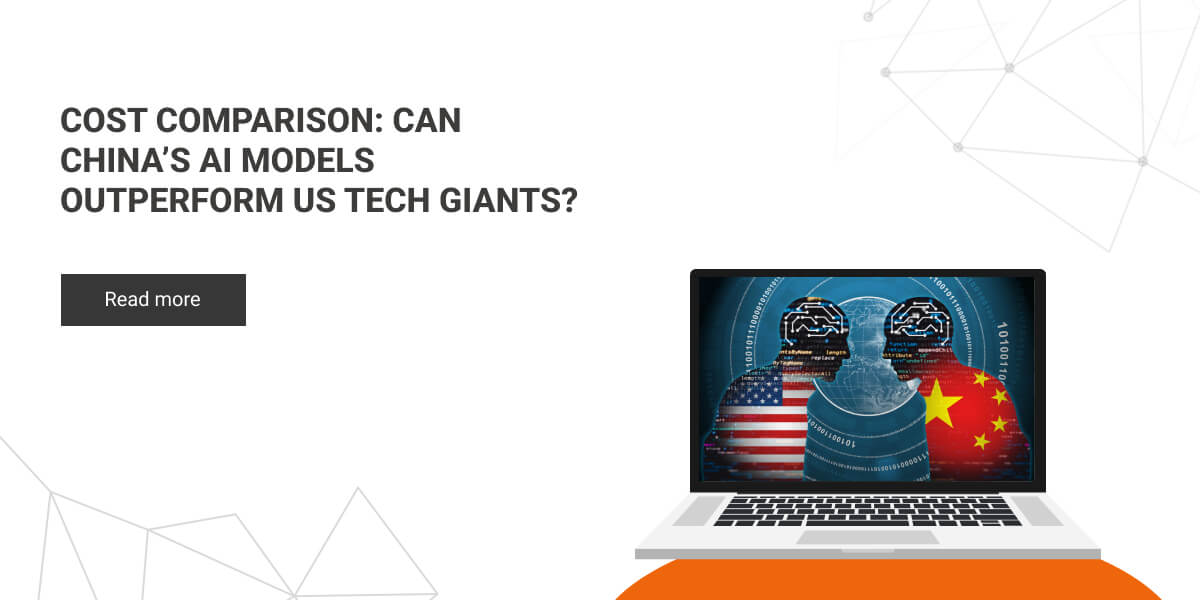
The recent launch of DeepSeek AI R1 model has turned heads in the AI Industry. According to China, they have spent only $6 million per training run on their model, compared to the tens of millions required for U.S. competitors. This is amazing right, the social is full of the buzz Deepseek vs Chatgpt? Moreover, Its commercial pricing is also impressively low. According to DocsBots Website mentioned by Statistica, with 1 million tokens costing only 55 cents to upload. This rapid success raises important questions: can a Chinese AI model truly challenge the U.S. AI dominators without sacrificing quality and security? In this post, we’ll compare cost and performance between top U.S. and Chinese AI infrastructures, to find out best open-source LLM mainly focusing on DeepSeek vs ChatGpt and others like Qwen, Gemini and Llama. We will also explore if China’s AI disruptors can truly outperform their U.S. counterparts. Understanding AI Infrastructure and LLM Costs AI infrastructure is a combination of hardware, software, and cloud services required to train and deploy AI models. When developing cutting-edge AI models like ChatGPT, Gemini, or DeepSeek, they require massive computational power which often involves specialized chips, vast datasets, and advanced training techniques. Typically, training a large language model (LLM) involves millions of dollars in computational costs. According to analysis, running ChatGPT costs approximately $700,000 a day. That breaks down to 36 cents for each question. The US models also demand extensive datasets, advanced algorithms, and constant tuning to ensure they perform at the highest level. Technical Components LLMs Require: The Evolution of AI Training Costs (2017-2023) The evolution of AI training costs has seen an astonishing rise over the years. It reflects the growing sophistication and scale of large language models (LLMs). AI training costs have soared from modest beginnings to reach hundreds of millions today. This rise reflects the growing complexity of large language models (LLMs). Let’s examine how the increasing sophistication of AI models has led to this sharp escalation in development expenses. The above image presents a fascinating timeline of AI model training costs from 2017 to 2023. It shows a dramatic increase in investment over the years. If you see the visualization, it notes that these figures are adjusted for inflation and were calculated based on training duration, hardware requirements, and cloud computing costs, according to The AI Index 2024 Annual Report. US AI Models – The Pioneers The U.S. has long been the leader in artificial intelligence development. Here are several tech giants that are driving innovation in tech space: It was developed by OpenAI and has revolutionized as conversational AI. With iterations like GPT-3 and GPT-4, it remains one of the most advanced models on the market. Training a model like ChatGPT costs upwards of $78 million, reflecting its complexity and the computational power required. ChatGPT app development costs can range anywhere between $100,000 to $500,000. The factors that affect the cost are the dataset’s size, the chatbot’s end-use case, the services, the features required, etc. Claude AI is created by Anthropic. The ai model has emerged as a leading conversational agent as it provides an alternative to ChatGPT with a focus on safety and alignment. The development costs are significant but vary depending on deployment and specific business use cases. Meta’s Llama series is a key competitor in the open-source AI space. While the models are cheaper to access for businesses, developing applications using Llama models still incurs considerable costs mainly for larger-scale integrations. Google’s Gemini is the most expensive AI model in terms of training costs, requiring $191 million for development. It’s designed to handle more complex datasets, including multimedia formats. Despite its higher costs, Gemini is known for its reliability and performance across various tasks. China’s AI Models: A Low-Cost Revolution Recently, China has begun making waves with its innovative, cost-effective alternatives. Chinese companies are challenging the traditional AI ecosystem by introducing similar or better performance at a fraction of the price. Here are some of the newest models of AI: DeepSeek AI launch of its R1 model has sent shockwaves through the AI industry. With a development cost of just $6 million, DeepSeek has proven that cutting-edge AI can be achieved on a lean budget. Its pricing structure is also far more accessible, with 1 million tokens costing only 55 cents to upload. Despite the lower costs, DeepSeek’s model has earned strong performance reviews, often outperforming U.S. models in key benchmarks. Last night, Alibaba launched their AI offerings, including the Qwen series. It quickly gained traction as a viable alternative to expensive models like GPT-4. With a heavy focus on cloud-based AI solutions, Alibaba provides highly competitive pricing, ensuring that businesses can scale AI-powered applications affordably. Moonshot’s Kimi series is a rising star in China’s AI scene. But, it is a less-known AI architecture. However, the Kimi K1.5 has been praised for its efficiency and cost-effectiveness. As it is giving companies an affordable way to implement AI without compromising on quality. The Chinese AI model, ByteDance is known for revolutionizing social media through TikTok, ByteDance is also making strides in AI. Doubao 1.5 Pro is one of their leading LLMs, offering impressive capabilities at a significantly lower cost compared to its Western counterparts. Estimating AI Development Costs The cost of AI development varies greatly depending on the scale, complexity, and project requirements. From infrastructure to labor, software, and training, each component contributes to the overall cost. On average, businesses can expect to invest between $10,000 to $50,000 or more in AI projects. Key Cost Components: Cost Breakdown: Is DeepSeek-R1 Really a Threat? In particular, DeepSeek-R1 has been disruptive due to its low costs and strong performance. But longevity is controversial. However, that model only spends $6 million per training run, far less than models like ChatGPT or Google’s Gemini, which can cost tens of millions. Its commercial use pricing also reflects this, with 1 million tokens costing only 55 cents to upload and $2.19 to download, which is significantly cheaper than U.S.-based
How Does RPA Empower SMBs in 2024 with Affordable Automation?

he introduction of artificial intelligence (AI) has reshaped almost every size of business by complex task automation. This transformation gave rise to new sophisticated tools like Copilots, RPA, Low-code and No-code platforms. Traditionally, industries struggled with high costs, lack of decision-making, errors in processes, inflexibility in legacy systems, repetitive tasks and difficulties in scaling operations to meet consumer demands. Collectively, these drawbacks led to customer dissatisfaction and overall lost productivity. In addition, there was a need for a scalable solution like RPA that could streamline operations, enhance accuracy, and reduce costs. But how? Let’s find out. In this article, you will learn what is robotic process automation, how RPA works, and how RPA and AI are making a difference in SMBs by automating processes while staying within What is Robotic Process Automation? Robotic Process Automation (RPA) is software used to automate repetitive tasks in business and IT processes. It functions with sets of instructions called software scripts. These scripts mimic the way a person would interact with software. It includes actions like clicking buttons, entering data, or navigating through menus. Moreover, using RPA time-consuming tasks and manual effort get automated. It results in allowing users to set up these scripts using coding or through easy-to-use tools. These tools do not require programming skills. Lastly, when the scripts are done, they can run automatically across different systems which will free up time for employees and they can focus on more valuable work. RPA use is growing day by day, according to GlobeNewswire, the global robotic process automation market size was valued at USD 2.8 billion in 2023. Now, the market is projected to grow from USD 38.4 billion by 2032, exhibiting a CAGR of 33.8% during the forecast period. How RPA Works? Robotic Process Automation (RPA) functions by automating many manual tasks to eliminate repetitive errors, making business processes smoother and more efficient. RPA functionality includes Six key aspects. All these functions make RPA handle a range of tasks which makes employees less burdened and drained ultimately no human errors and more focus on other tasks. Here are the key aspects: RPA Benefits for SMBs RPA can provide numerous benefits to every size of business, including quick scalability, streamlining operations, saving costs, and allowing small teams to handle higher workloads with greater accuracy. Here are some key benefits of RPA that can help smaller businesses compete more effectively: 1. Boosts Efficiency: Robotic Process Automation for SMBs can automate manual and repetitive tasks that are time-consuming and prone to human errors including data entry, report generation, and inventory updates. When bots handle these processes 24/7, businesses get improved turnaround times. Their employees can focus on high-value activities to work more efficiently and for SMBs, there’s no need to hire additional staff. 2. Reduces Costs: SMBs usually have budget constraints when it comes to hiring more resources. However, RPA offers a cost-effective way to achieve more without hiring or outsourcing any resources. RPA and AI automate labour-intensive tasks which cut down on labor costs and minimizes the expenses related to human errors. As a result, it allows SMBs to reinvest the savings into growth areas like product development or customer acquisition. 3. Improves Accuracy and Reliability: RPA reduces human error in tasks including invoice processing, order entry, and payroll. These are areas where SMBs could cost more if there is any mistake. However, integration of RPA in business can provide only consistent and accurate results. reducing the need for rework and building customer trust by delivering reliable services. 4. Enables Scalability and Flexibility: RPA for small business is a scalable solution that can adapt to their growth. As business demands fluctuate, bots can be scaled up or down. It allow SMBs to meet seasonal or unexpected spikes in work without the tiredness of hiring temporary staff. In addition, the flexibility provides value to small businesses looking to grow sustainably. 5. Enhances Compliance and Security: Small businesses from industries like finance or healthcare(regulated industries) face strict compliance requirements. But, if RPA is integrated, it helps ensure that all tasks follow set rules and maintain accurate logs for audits. It can automate data handling and process tasks in no time. As a result, SMBs can thrive with more easily meet compliance standards. Also, there will be a reduced risk and a protected business reputation. Use Cases of RPA for Businesses RPA can go further from streamlining processes and addressing practical needs in real-time. It can boost operational efficiency across various industries. Here are RPA use cases with it’s additional practical applications: 1. RPA in Customer Service: Robotic Process Automation can make routine customer inquiries automated. It includes tasks like account updates, order tracking, and FAQs. Further, it can handle data entry and transfer between systems to enable agents to focus on more complex customer issues. In addition, RPA provides instant responses to customers through chatbots and automatically updates CRM systems with customer interaction details. Ultimately, ensuring a complete history for future service needs. 2. RPA in E-commerce: RPA in e-commerce automates order tracking to keep customers updated at each stage mentioned in the image above. This type of automation reduces the need for manual support. It provides timely notifications which keeps customers informed throughout the shipping process. The major benefit of RPA for e-commerce businesses is that it enhances satisfaction and reduces “Where is my order?” queries. These routine updates if automated, e-commerce companies can surely improve efficiency and focus on complex customer needs. 3. RPA in Accounting: RPA in fintech is utilized for the automation of invoice processing, accounts payable/receivable, financial reporting, and compliance checks. These complex tasks when done by humans repetitively can be prone to errors. That is why automating these tasks ensures timely financial management. Moreover, RPA reconciles bank statements with financial records and automatically flags discrepancies. As a result, it helps maintain accurate records without manual effort. 4. RPA in Banking: RPA in banking can be used to automate tasks like loan processing, customer onboarding, fraud detection, and compliance
A Transformative Journey from LLMs to Micro-LLMs

Introduction AI is a most discussed topic of today. Recently platforms like Medium, Reddit, and Quora had so many posts about “AI hype is dead” and “AI is a washed-up concept from yesterday”. Well, they’re half right because “AI is already everywhere now”, transforming businesses, disrupting enterprises, automating tasks, and making decisions like a boss. The potential is shown from developments in AI like NLP, deep learning and then Large Language Models (LLMs) like GPT-3 and GPT-4. These models are powerful and massive. They transform businesses by automating tasks and making intelligent decisions. But, with great power comes great resource demands which led to the rise of Small Language Models (SLMs) and Micro-LLMs. These models are more efficient and targeted for specific tasks. According to Lexalytics, micromodels offer precision with fewer resources. So, do smaller models make a bigger impact on businesses? Let’s find out which model is better for businesses and enterprise success! LLMs – The Powerhouse of AI For over a thousand years, humans have strived to develop spoken languages to communicate. The main purpose was to encourage development and collaboration through language. In the AI world, language models are creating a foundation for machines to communicate and generate new concepts. LLM refers to a large language model. A type of AI algorithm with the underlying technology of deep learning techniques and huge data sets to understand, summarize, generate and predict new content. GenAI or the term generative AI is also related to LLMs because they have been specifically architected to help generate text-based content. Furthermore, LLMs utilize transformer architectures. In 2017, a paper titled as “Attention is all you need” was published by Google to achieve tasks like content generation, translation, and summarization. Transformers use positional encoding and self-attention mechanisms. These aspects allow models to process large datasets efficiently and understand complex relationships between data points. Because of this, LLMs can handle vast information streams which makes them a powerful tool for generating and interpreting textual information. The image shows various transformer-based language models with different numbers of parameters. Different parameters reflect LLMs’ complexity and capabilities. The models in this category include GPT-4, GPT-3, Turing-NLG, GPT-NEO, GPT-2, and BERT. However, GPT-4 is the most advanced and has 1 trillion parameters. On the other hand, GPT-3 have 175 billion. These numbers make them the most powerful and widely used models. They can generate human-like text and can make complex decisions by learning context from large-scale datasets provided. For instance, GPT-4 can be used in: Significant Challenges of LLMs We know that large language model are known for their massive power. Apart from being massive, LLMs face significant challenges like: Latest Advancements in LLMs Despite the challenges, LLMs for enterprise AI solutions is revolutionizing by offering AI systems capable of learning and generating human-like content across numerous domains. Moreover, the complexity of LLMs gave rise to more advancements in models like encoder-only, decoder-only, and encoder-decoder models. Each model is best suited for different use cases such as classification, generation, or translation. Let’s understand each: Encoder-only models: Decoder-only models Encoder-decoder models Examples of Real-Life LLMs AI is evolving continuously and more and more developments are happening. These models are significant tools that are advancing open research and developing efficient AI applications. Here are some open-source large language models: For the designer: Add logos of each in one picture and add here. Small Language Models: The Solution to LLM’s Challenges While, LLM faces high computational costs, extensive data requirements, and significant infrastructure needs, Small Language Models (SLMs) provide a balanced solution with maintained strong performance and reduced resource burden. Within the vast domain of AI, Small Language Models (SLMs) stand as a subset of Natural Language Processing (NLP). These models have a compact architecture which costs less computational power. They are designed to perform specific language tasks, with a degree of efficiency and specificity that distinguishes them from their Large Language Model (LLM) counterparts. Furthermore, experts at IBM believes that Lightweight AI models for business optimization are best for data security, development and deployment. These features significantly enhance SLM appeal for enterprises, particularly in LLM evaluation results, accuracy, protecting sensitive information, and ensuring privacy. Focused Solutions With Small Language Models SLMs can target specific tasks, like customer service automation and real-time language processing. Being small in size, its more easy to deploy with low cost and fast processing time. Experts says that Low-resource AI models for business are ideal for businesses that need efficient, task-focused AI systems without the enormous computational footprint of LLMs. They also mitigate risks related to data privacy, as they can be deployed on-premises. As a result, they reduce the need for vast cloud infrastructure. Moreover, SLMs require less data which offers improved precision. This feature makes small language model more suitable for healthcare and finance sectors where privacy and efficiency is mandatory. Moreover, they excel at tasks like sentimental analysis, customer interaction and document summarization. These tasks usually require fast, accurate, and low-latency responses. In essence, SLMs provide businesses with the performance they need without the overwhelming demands of LLMs. SLMs For Industries Small Language Models (SLMs) are not only limited to their cost efficient quality but it has transformed many industries. The major benefit it offers is being efficient and task-specific AI solution that is why it is best for healthcare and customer support that needs quick deployment and precision. Lets see how: SLM in Healthcare: Domain-specific SLMs are fine-tuned. This make SLM handle medical terminologies, patient records, and research data. SLM in healthcare can provide benefits like: These aspects make SLM more efficient in healthcare by being helpful in diagnostic suggestions and summarizing records. SLM in Customer Service: SLM and Micro-LLM can similarly be deployed in customer service. They can automate responses based on past interactions, product details, and FAQs. They provide benefits in customer service like: These features make them a faster solutions to boost customer satisfaction and allow human agents to focus on complex issues. Phi-3: Redefining SLMs Microsoft developed a
Ethical Considerations in AI: Innovation with Responsibility
How AI Has Changed The World AI has brought major advancements in efficiency, cost reduction, and outcome improvement throughout multiple sectors around the globe. In healthcare, AI algorithms like those from Google Health can diagnose diseases such as diabetic retinopathy and breast cancer with remarkable accuracy, and AI-driven drug discovery has drastically reduced development timelines, exemplified by BenevolentAI’s rapid identification of a candidate for ALS treatment. The finance sector benefits from AI-powered fraud detection systems, which cut false positives by over 50%, and algorithmic trading that enhances market efficiency through real-time data analysis. Retail giants like Amazon and Alibaba leverage AI for personalized recommendations, boosting sales by up to 35%, while AI-driven inventory management optimizes stock levels, reducing waste. Manufacturing has seen reductions in downtime and waste through predictive maintenance and AI-enhanced quality control, with companies like BMW improving defect detection. Agriculture benefits from AI through precision farming, which increases crop yields by up to 25% while conserving resources, and AI-driven pest control that minimizes crop damage and pesticide use. These applications underscore AI’s critical role in revolutionizing various sectors, leading to enhanced operational efficiency and superior outcomes. The Problem AI’s potential is vast, impacting fields from healthcare and finance to policies and laws, but there are some issues that cannot be ignored. AI systems are often trained on large datasets, and the quality of these datasets significantly impacts the fairness of the AI’s decisions. This issue is not just theoretical; with facial recognition technology, it has been found that error rates of up to 34% are present for dark-skinned women, compared to less than 1% for light-skinned men. In natural language processing (NLP), word embeddings like Word2Vec or GloVe can capture and reflect societal biases present in the training data, which leads to biased outcomes in applications such as hiring algorithms or criminal justice systems. Think of this: if an AI system gives a wrong diagnosis, who is accountable—the AI developers or the doctors who use it? If a self-driving car causes an accident, is the manufacturer responsible? There are major issues concerning privacy as well when AI comes to the picture. A report from the International Association of Privacy Professionals (IAPP) found that 92% of companies collect more data than necessary, posing risks to user privacy. Differential privacy, for example, can add noise to datasets, protecting individual identities while allowing for accurate data analysis.In the UK, an AI system used in healthcare incorrectly denied benefits to nearly 6,000 people, highlighting the consequences of opaque decision-making processes. AI’s capacity for automation presents both opportunities and challenges. While AI is expected to create 2.3 million jobs, it may also displace 1.8 million roles, particularly in low-skilled sectors. Ethical Considerations Regarding AI Utilitarianism, which advocates for actions that maximize overall happiness and reduce suffering, provides a framework for evaluating AI; AI systems designed to improve healthcare outcomes align with utilitarian principles by potentially saving lives and alleviating pain. For example, AI algorithms used in predictive diagnostics can identify early signs of diseases, leading to timely interventions and improved patient outcomes, as demonstrated by studies showing AI’s superior accuracy in diagnosing conditions like diabetic retinopathy and breast cancer. However, utilitarianism also raises questions about the distribution of benefits and harms: an AI system that benefits the majority but marginalizes a minority may be considered ethical by utilitarian standards, yet it poses serious concerns about fairness and justice. For instance, facial recognition technology, while useful for security purposes, has been shown to have higher error rates for minority groups, potentially leading to disproportionate harm. In another perspective, deontological ethics, which emphasizes the importance of following moral principles and duties, offers another lens for examining AI; certain actions are inherently right or wrong, regardless of their consequences. For instance, an AI system that violates individual privacy for the sake of efficiency would be deemed unethical under deontological ethics. The use of AI in surveillance, which often involves extensive data collection and monitoring, raises significant ethical concerns about privacy and autonomy. Challenges in Ethics for AI One of the significant challenges in AI is the “black box” nature of many algorithms, which makes it difficult to understand how they arrive at specific decisions. For example, Amazon had to scrap an AI recruiting tool after discovering it was biased against women, largely due to training data that reflected historical gender biases in hiring practices. Similarly, AI systems used in lending have been found to disproportionately disadvantage minority applicants due to biased data inputs, perpetuating existing social inequalities. Transparency and explainability are essential for building trust and ensuring that AI systems operate as intended. Without transparency, stakeholders—including developers, users, and regulatory bodies—cannot fully assess or trust the decisions made by AI systems. This lack of transparency can erode public confidence and hinder the broader adoption of AI technologies. Bias in AI systems is another critical ethical challenge. AI algorithms can inadvertently perpetuate and amplify existing societal biases present in training data. For instance, predictive policing algorithms have been criticized for reinforcing racial biases, leading to disproportionate targeting of minority communities. Addressing these biases requires a multifaceted approach, including diversifying training datasets, employing bias detection and mitigation techniques, and involving diverse teams in the development process. Regulations like the European Union’s General Data Protection Regulation (GDPR) emphasize the right to explanation, mandating that individuals can understand and challenge decisions made by automated systems. This regulatory framework aims to ensure that AI systems are transparent and that their operators are accountable. Similarly, the Algorithmic Accountability Act introduced in the United States requires companies to assess the impact of their automated decision systems and mitigate any biases detected. Practical and Ethical Solutions for AI Techniques such as Explainable AI (XAI) and audit trails are essential for making AI systems more transparent; XAI methods like LIME and SHAP provide insights into how models make decisions, enabling users to understand and trust AI outputs. Google’s AI Principles advocate for responsible AI use, emphasizing the need to avoid creating or reinforcing unfair
How Generative AI is Reshaping Job Requirements

Defining Generative Artificial Intelligence Generative AI marks a transformative time in Artificial Intelligence, permanently altering how data is created and processed; unlike traditional AI models, which operate in predefined parameters and follow rule-based algorithms, Generative AI utilizes advanced Deep Learning architectures to create new, high-quality data. This technology includes cutting-edge models like OpenAI’s GPT-4, which excels in natural language understanding and generation, and DeepMind’s AlphaFold, renowned for its groundbreaking ability to predict protein structures with unprecedented accuracy. GANs employ a dual-network approach to improve the authenticity of generated data by evaluating and refining it through a game-theoretic framework, and VAEs encode input data into a latent space. The impact of Generative AI extends beyond technical advancements, reshaping workforce competencies and job roles; the demand for skills in AI and machine learning frameworks like TensorFlow and PyTorch is surging, as professionals need to develop and deploy these sophisticated models. As this technology continues to evolve, it will undoubtedly lead to further advancements and applications, transforming industries and redefining the boundaries of what AI can achieve. An Overview of the Intricate Structures Within Generative AIs Generative AI operates using sophisticated neural network architectures that emulate the structure and function of the human brain, allowing for a more nuanced understanding and generation of complex data. For instance, GPT-4, with its 175 billion parameters, not only generates human-like text but also performs tasks such as language translation, summarization, and creative writing with remarkable coherence and relevance. AlphaFold‘s ability to predict protein structures has dramatically accelerated research in drug discovery and disease treatment by providing insights into protein folding processes that were previously computationally prohibitive. GANs are employed in diverse applications, including the creation of hyper-realistic images, video generation, and synthetic data production for training other AI models. Programming skills in languages such as Python and R are essential for implementing and fine-tuning AI algorithms, as Python’s versatility and extensive libraries are particularly advantageous for AI development, while R’s statistical capabilities support in-depth data analysis. The Types of Generative AI Generative Pre-trained Transformers (GPTs) are a type of language model built on a transformer-based architecture, using a deep understanding of context and the generation of human-like text. Central to their functionality are self-attention mechanisms that allow the model to weigh the importance of each word in a sentence relative to the others. This capability enables GPT models to produce text that is not only coherent but also contextually relevant, making them highly effective for various applications, including content creation, language translation, and interactive conversational agents. For instance, GPT-4, developed by OpenAI, can generate diverse forms of text, from drafting emails to composing essays, and is used in applications ranging from automated customer support to advanced research assistance. These models are also instrumental in developing conversational agents like chatbots that can understand and respond to user queries with high accuracy. Generative Adversarial Networks (GANs) operate through a dual-network setup consisting of a generator and a discriminator. The generator’s role is to create synthetic data, while the discriminator’s task is to evaluate this data against real examples to determine its authenticity. This adversarial process leads to continuous improvement in the quality of generated data as the generator learns to produce more realistic outputs and the discriminator refines its evaluative criteria. GANs have broad applications, including in image synthesis where they are used to create photorealistic images from sketches or low-resolution images, video generation for producing realistic motion sequences, and data augmentation to generate diverse training data for other AI models. Variational Autoencoders (VAEs) are another class of generative models that blend probabilistic graphical models with neural networks. VAEs encode input data into a latent space—a compressed, lower-dimensional representation—and then decode this representation to reconstruct the original data. This process allows VAEs to generate new samples that are similar to the training data, making them useful in various applications such as anomaly detection, where they can identify outliers or unusual patterns by comparing reconstructions to original data, data denoising, where they clean noisy data, and generative art, where they create novel artistic outputs based on learned data distributions. Reinforcement Learning (RL) is a different approach that involves agents learning to make decisions by interacting with their environment and receiving rewards or penalties based on their actions. This method allows agents to develop complex strategies for tasks by trial and error, optimizing their behavior through iterative feedback. RL has seen significant advancements in applications such as robotics, where it helps robots learn precise manipulation tasks; autonomous vehicles, where it is used for navigating and decision-making in dynamic environments; and dynamic system optimization, where RL techniques optimize systems such as supply chains or energy management. Generative AIs Impact on Job Roles in Industries Routine task automation through AI tools is reshaping various sectors by reducing administrative overhead and operational costs. In administrative functions, automation is applied to scheduling, data entry, and document management, which enhances operational efficiency and accuracy. AI-powered systems, such as robotic process automation (RPA) tools, handle repetitive tasks with minimal human intervention, freeing up employees to focus on more complex and strategic responsibilities. This shift not only increases productivity but also reduces errors associated with manual data handling and scheduling. AI-driven robotics are revolutionizing production lines by managing assembly processes and quality control with remarkable precision. Advanced robotics equipped with AI algorithms are capable of performing complex tasks such as intricate assembly, defect detection, and predictive maintenance. These robots operate with high efficiency and consistency, leading to reduced manual labor, lower operational costs, and higher-quality products. For example, AI-enabled robots in automotive manufacturing can assemble components with precision and speed, leading to enhanced production efficiency and reduced downtime. AI-powered robots and automation systems improve precision and efficiency on production lines, while predictive maintenance algorithms prevent equipment failures by forecasting potential issues before they arise. AI systems improve clinical decision-making by assisting with diagnostic imaging, treatment recommendations, and patient management. Tools like IBM Watson Health leverage AI to analyze medical records and research, aiding in personalized treatment
Proof of Less Work:Sustainability in the Blockchain Era

Blockchain technology, celebrated for its decentralized and secure nature, has come under criticism for its environmental impact, particularly through its major use of the Proof of Work (PoW) mechanism. The PoW model, which works under major cryptocurrencies like Bitcoin, is known for its high energy consumption. To cater to these concerns, the concept of Proof of Less Work (PoLW) has emerged as a potential solution. What is Proof of Less Work (PoLW) Imagine a highly secure digital ledger where all your transactions are recorded. But there’s a problem; many blockchains, such as the one that runs Bitcoin, use a method called Proof of Work (PoW) to keep data secure. In PoW, computers solve extremely hard puzzles to add new blocks to the blockchain, which guzzles up huge amounts of electricity. Is it possible to keep blockchains eco-friendly without turning our planet into a giant oven? Yes! Instead of making computers work extra hard, the new mechanism Proof of Less Work (PoLW) uses easier tasks that require way less energy: PoLW is a different approach to adding blocks to the blockchain that uses less energy; instead of solving extremely hard puzzles, PoLW gives easier tasks that don’t require as much power from computers. These tasks still help validate and secure the blockchain but don’t require as much energy to solve; instead of those brain-melting puzzles, PoLW gives out easier tasks such as solving real-world problems that require less power i.e optimizing mathematical problems, and contributing to scientific research projects that need less intensive computing power. By using less energy, PoLW helps reduce the massive carbon footprint associated with traditional PoW. Here is an outline of how the PoLW system works: Why is Proof of Less Work (PoLW) Needed According to research conducted by Cambridge Centre for Alternative Finance, Bitcoin mining alone consumes around 121.36 terawatt-hours (TWh) per year, which is comparable to the annual energy consumption of a country like Argentina. To put it into perspective, the energy used by Bitcoin mining in a single year could power the entire city of New York for nearly four years. This massive energy requirement is driven by the need for miners to continuously run specialized hardware, known as Application-Specific Integrated Circuits (ASICs), to solve complex cryptographic puzzles. This high energy demand results in a significant carbon footprint, contributing to climate change and environmental degradation. The bulk of this energy consumption comes from specialized hardware (ASICs) running continuously to solve the puzzles. The primary critique of the traditional Proof of Work is its energy consumption; the need for massive computational power leads to substantial electricity use, contributing to a large carbon footprint. The majority of Bitcoin mining operations are powered by fossil fuels, particularly coal, which is a major source of carbon emissions. Bitcoin’s annual carbon footprint is comparable to that of countries like Qatar and Hungary, which equates to approximately 60 million metric tons of CO2 emissions per year, contributing to global warming and climate change. In Proof of Work (PoW), the competition among miners to solve puzzles first means that more powerful and energy-hungry hardware is constantly being developed and deployed. This creates a cycle of increasing energy consumption and e-waste, as older hardware becomes obsolete and is discarded. The new and improved mechanism Proof of Less Work (PoLW) enhances the economic viability of blockchain networks by lowering operational costs. Miners can use less expensive hardware and spend less on electricity, making mining more accessible and profitable. This democratization of mining can lead to a more decentralized and resilient blockchain network. To encourage miners to use PoLW, the system offers rewards or incentives for those who complete the easier tasks. Miners who use renewable energy or more efficient methods might get extra rewards, for example, a miner using solar or wind power could receive additional rewards or priority in the validation process. This helps promote environmentally friendly practices. How Do We Transition to PoLW For existing blockchain systems that use PoW, switching to PoLW can be done gradually as it would be a complicated process. The transition requires careful planning, collaboration, and a willingness to embrace new paradigms in blockchain technology which involves either of the following methods: 1- Soft Forks and Hard Forks Soft Forks: Hard Forks: 2- Hybrid Systems Gradual Transition: Example of Hybrid Implementation: How Does PoLW Add Value to Blockchain Ecosystem PoLW helps blockchain work in a way that saves energy and protects the environment by giving computers easy jobs instead of hard puzzles. This allows the network to process more transactions per unit of energy consumed. Estimates by research studies suggest that switching to PoLW could reduce energy consumption by over 90% compared to traditional PoW systems. Final Words and Future Directions One of the main technical challenges in transitioning to PoLW is ensuring that the new system can handle the same volume of transactions as PoW without compromising on performance, and developing and optimizing algorithms that are energy-efficient yet secure and effective in validating transactions is key to overcoming this challenge. Meanwhile, ensuring that PoLW maintains the same level of security as PoW is critical. This involves rigorous testing and validation of the new consensus mechanism to prevent vulnerabilities and attacks. Collaboration between academia, industry, and environmental organizations can drive this innovation and adoption of its use. In conclusion, adopting sustainable practices like PoLW will be crucial in environmental impacts and ensuring a greener future. The benefits of PoLW are bountiful; it dramatically reduces energy consumption and operational costs, making blockchain mining more accessible and profitable. This democratization of mining can lead to a more decentralized and resilient blockchain network. Furthermore, by promoting energy-efficient and renewable energy practices, PoLW contributes to a substantial reduction in the carbon footprint of blockchain technology, aligning it with global sustainability goals. To ensure successful implementation of PoLW, strong support from the blockchain community and developers is required, in addition to engaging with stakeholders through forums, workshops, and collaborative projects facilitating a much smoother transition and incentive to adopt this
Redefining Ethereum Accounts Through ERC4337

Initially, Ethereum used an account-based model with externally-owned accounts (EOAs) controlled by public and private keys, but users needed EOAs to initiate transactions and pay gas fees which involved multiple steps and confirmations, making the process tedious. Losing private keys also meant losing funds permanently. With the introduction of ERC 4337, the creation of smart contract wallets without altering Ethereum’s protocol was now possible. It introduces a “pseudo-transaction” called UserOperation, which can be bundled and processed by the EntryPoint smart contract, streamlining transactions and eliminating private key dependencies. What is Account Abstraction: Account abstraction is a method in blockchain where user assets are stored in smart contracts instead of traditional external accounts (EOAs). This turns a crypto wallet into a programmable smart contract. Account abstraction offers a solution by improving the user experience and security of self-custodial wallets, removing reliance on private keys, and making wallets programmable. It also customizes user accounts through smart contracts, reducing risks and enhancing functionality, making it a critical step toward mass adoption of Web3. Blockchain wallets are currently clunky and limited, much like using a flip phone in today’s world. The complexity and security concerns associated with 16-word seed phrases and private keys make it difficult to onboard the next billion users into Web3. The cryptocurrency community believes EOAs limit user interactions with Ethereum, especially for batching transactions and managing gas costs; account abstraction addresses these issues, increasing security and improving user experience by offering features like backup keys, trusted party delegation, and multi-signature requirements. Below are some of the benefits of account abstraction to Web3 segments: Why There is a Need for ERC 4337: Ethereum account abstraction offers a more user-friendly experience for interacting with decentralized applications (DApps) by storing assets in smart contracts instead of externally-owned accounts (EOAs). While Ethereum supports account abstraction, it is not the default setting, necessitating additional configurations for both users and developers. The introduction of the ERC-4337 standard in March 2023 marked a significant advancement in this area, enabling account abstraction and improving wallet design and user experience through the use of a smart contract called EntryPoint. This innovation is compatible with all Ethereum Virtual Machine (EVM) networks, ensuring broad applicability. ERC-4337 allows for the conversion of traditional wallets into smart contract accounts, significantly enhancing user convenience. By eliminating the reliance on private keys, ERC-4337 mitigates the risk of key loss without necessitating substantial changes to the underlying blockchain. This standard introduces a more efficient way to handle transactions, simplifying the process and reducing the number of steps and confirmations required. As a result, overall efficiency and user satisfaction are greatly enhanced. ERC-4337 transforms the way users interact with Ethereum, making it easier and safer to manage digital assets, thereby addressing critical pain points in the current system and paving the way for broader adoption of blockchain technology. Here are some of the technical benefits of ERC 4337 integration: Limitations to the ERC 4337 Standard: Firstly, while ERC 4337 enables the creation of smart contract wallets without altering Ethereum’s core protocol, it still requires additional configurations from both users and developers. This added complexity can be a barrier to adoption, particularly for those new to the blockchain ecosystem. The introduction of “pseudo-transactions” through the UserOperation mechanism, although streamlining the process, might introduce new vectors for vulnerabilities and attacks that need thorough vetting and mitigation. The reliance on the EntryPoint smart contract for bundling and processing transactions could potentially create bottlenecks or single points of failure, impacting the network’s efficiency and security. The transition from traditional externally-owned accounts (EOAs) to account abstraction models might also face resistance due to entrenched practices and the initial learning curve associated with adopting new systems. Finally, while ERC 4337 is compatible with all Ethereum Virtual Machine (EVM) networks, ensuring seamless integration and widespread adoption across diverse platforms might require significant effort and coordination. These challenges highlight the need for ongoing development and community engagement to fully realize the potential benefits of ERC 4337 while addressing its limitations. Conclusion: Account abstraction represents a significant shift in blockchain interactions, making them more secure and user-friendly. Ecosystems with native AA support, like Starknet, are at the forefront of this innovation, facilitating widespread adoption. Account abstraction enhances user security and functionality, making it a promising future technology for widespread adoption. It makes it possible for smart contracts to handle transactions more like EOAs, enabling things like batch transactions, where multiple actions are bundled into one. To improve the overall program, ERC 4337 allows more sophisticated security measures in smart contracts with reduction in risk of losing funds through mistakes or hacks. Instead of every transaction being a simple send/receive, user operations can include complex sequences of actions, making the blockchain more efficient. ERC 4337 aims to make Ethereum smarter, safer, and more user-friendly by enhancing how transactions and smart contracts work together. To learn more about ERC 4337 and how Ethereum is paving a new path for Web3 platforms, contact our technology experts now at info@optimusfox.com
Copilots and Generative AI’s Impact on RPA

The convergence of Robotic Process Automation (RPA) with Copilots and Generative AI marks a significant transformation in automating business processes. This integration leverages the advanced capabilities of AI models to enhance the functionality, efficiency, and scope of RPA, paving the way for more intelligent, autonomous, and adaptive systems. In the modern business landscape, technology continues to reshape the way organizations operate. Two prominent advancements driving this transformation are Copilots and Robotic Process Automation (RPA). These technologies are revolutionizing workflows and boosting efficiency across various industries. Understanding the Components Robotic Process Automation (RPA) Robotic Process Automation (RPA) leverages software robots to perform repetitive, rule-based tasks that were traditionally executed by humans, including data extraction, transaction processing, and interaction with digital systems via graphical user interfaces (GUIs). Data extraction involves web scraping and document processing using OCR technology, while transaction processing covers financial transactions like payment processing and order fulfillment in supply chain management. RPA bots also integrate with different software systems and handle customer service through chatbots and virtual assistants. Leading RPA platforms like UiPath, Automation Anywhere, and Blue Prism facilitate the development, deployment, and management of RPA bots. UiPath offers an integrated development environment for designing workflows, a centralized platform for managing bots, and software agents that execute workflows. Automation Anywhere provides a cloud-native platform with tools for bot creation and management, real-time analytics, and cognitive automation for processing unstructured data. Blue Prism includes a visual process designer for creating workflows, a management interface for controlling automation processes, and scalable bots known as Digital Workers. Enhancements in RPA include the integration of artificial intelligence (AI) capabilities like machine learning, natural language processing, and computer vision, allowing RPA to handle more complex tasks. Modern RPA platforms support cloud deployments, enabling scalable and flexible automation solutions that can be managed remotely. Security features like role-based access control, data encryption, and audit trails ensure compliance with regulatory standards, and automated compliance checks help maintain adherence to legal requirements. Copilots Copilots are sophisticated AI-driven tools engineered to assist human users by providing context-aware recommendations, automating segments of workflows, and autonomously executing complex tasks. They utilize Natural Language Processing (NLP) and Machine Learning (ML) to comprehend, anticipate, and respond to user requirements. These tools can analyze large volumes of data in real-time to derive actionable insights, thereby enhancing decision-making processes. By understanding natural language, Copilots can interpret user instructions and convert them into executable tasks, reducing the need for manual intervention. For instance, they can automatically draft emails, generate reports, or suggest actions based on user queries. This capability significantly streamlines workflows and boosts productivity. Machine Learning enables Copilots to learn from historical data and user interactions, allowing them to improve their performance over time. They can identify patterns and trends, predict future outcomes, and provide proactive recommendations. For example, in a customer service context, Copilots can analyze past interactions to offer personalized responses, anticipate customer needs, and suggest the best course of action to the service agents. Copilots can integrate seamlessly with various enterprise systems and applications, providing a unified interface for users to manage multiple tasks. They can autonomously handle routine tasks like scheduling meetings, managing calendars, and processing data entries, freeing up human resources for more strategic activities. In advanced applications, Copilots can interact with IoT devices, monitor system performance, and trigger corrective actions without human intervention. This level of automation and intelligence transforms how businesses operate, driving efficiency and innovation. The deployment of Copilots across industries demonstrates their versatility and impact. In healthcare, they assist in patient management and diagnostics. In finance, they automate compliance reporting and risk assessment. In manufacturing, they optimize supply chain logistics and predictive maintenance. The continuous advancements in NLP and ML are expanding the capabilities of Copilots, making them indispensable tools in the digital transformation journey of organizations. Generative AI Generative AI encompasses sophisticated algorithms, primarily neural networks, that are capable of generating new data closely resembling the data they were trained on. This includes a range of models such as GPT-4, DALL-E, and Codex, each excelling in producing human-like text, images, and even code snippets. These models utilize deep learning techniques to achieve remarkable results, particularly leveraging architectures like transformers and Generative Adversarial Networks (GANs). Transformers are a type of model architecture that has revolutionized natural language processing by allowing models to understand and generate human-like text. They use mechanisms such as self-attention to weigh the importance of different words in a sentence, enabling the creation of coherent and contextually accurate responses. GPT-4, for example, is a transformer-based model that can engage in complex conversations, answer questions, and even generate creative content like stories and essays. GANs, on the other hand, consist of two neural networks: a generator and a discriminator. Generative AI’s capabilities extend beyond text and images to include code generation. Codex, for instance, can understand and write code snippets in various programming languages, making it a valuable tool for software development. It can assist in automating coding tasks, debugging, and even creating entire applications based on user specifications. These models are trained on vast datasets, allowing them to learn the intricacies and nuances of the data they are exposed to. For example, GPT-4 has been trained on diverse internet text, giving it a broad understanding of language and context. DALL-E and similar models are trained on image-text pairs, enabling them to associate visual elements with descriptive language. The applications of generative AI are vast and varied. In creative industries, these models are used to generate original artwork, music, and literature. In business, they can automate content creation for marketing, generate synthetic data for training other AI models, and even create realistic virtual environments for simulations. In healthcare, generative AI can help design new drugs by simulating molecular structures and predicting their interactions. How Copilots and Generative AI Adds Value in RPA Advanced decision-making in Robotic Process Automation (RPA) involves two key components: model training and real-time analysis. Generative AI models are trained on extensive datasets that include historical process data, transactional
CCIP – Unlocking Seamless Blockchain Interoperability

The blockchain ecosystem is rapidly expanding, with numerous independent networks emerging. However, a significant challenge remains: facilitating communication between these disparate blockchains. This is where the Cross-Chain Interoperability Protocol (CCIP) steps in, offering the best solution for easy interaction across all blockchain networks. The main goals of CCIP are to enhance the ability of decentralized applications (dApps) to operate across multiple blockchains, improve the efficiency and security of cross-chain transactions, and support the development of a more interconnected blockchain ecosystem. What is CCIP? CCIP, or Cross-Chain Interoperability Protocol, is a comprehensive set of rules and technologies designed to enable different blockchain networks to communicate effectively. Think of CCIP as a translator that allows two people speaking different languages to understand each other. This protocol simplifies the process of exchanging information and assets between blockchains, ensuring a more integrated and efficient blockchain ecosystem. Here are some key features of CCIP: Why Do We Need CCIP? Imagine owning digital assets like cryptocurrencies or tokens on Blockchain A but wanting to use them on Blockchain B. Without CCIP, this process is cumbersome, involving multiple steps and considerable risk. CCIP provides a streamlined, secure method for transferring assets and data between blockchains, eliminating the need for complex and risky procedures. The Cross-Chain Interoperability Protocol (CCIP) addresses these challenges by providing a framework for secure and efficient cross-chain communication. Here’s a technical dive into why we need CCIP: 1. Eliminating Siloed Networks Problem: Blockchain networks often operate in silos, with no native mechanism for interaction with other chains. This isolation limits the functionality of decentralized applications (dApps) and restricts the flow of assets and data. Solution: CCIP provides a set of standardized rules and technologies that facilitate seamless communication between disparate blockchain networks. By enabling cross-chain interactions, CCIP breaks down these silos, allowing for more integrated and functional dApps. 2. Secure Cross-Chain Transactions Problem: Transferring assets between blockchains traditionally involves complex, multi-step processes that are prone to security risks, such as double-spending and replay attacks. Solution: CCIP employs robust security mechanisms, including decentralized oracles and consensus validation, to ensure the integrity of cross-chain transactions. This minimizes the risk of tampering and ensures that transactions are secure and reliable. 3. Standardized Communication Protocol Problem: Without a standardized protocol, developers face significant challenges in creating interoperable solutions. Each blockchain has its own set of rules and communication methods, leading to increased complexity and potential errors. Solution: CCIP offers a standardized framework for cross-chain interactions. This standardization simplifies the development process, allowing developers to create interoperable solutions more easily and efficiently. It provides common interfaces and protocols that can be universally adopted across different blockchain networks. 4. Scalability for Large-Scale Applications Problem: As the number of blockchain applications grows, the need for scalable solutions that can handle a high volume of transactions becomes critical. Current cross-chain solutions often struggle with scalability issues, limiting their applicability for large-scale applications. Solution: CCIP is designed with scalability in mind. Its architecture supports a high throughput of transactions, making it suitable for large-scale applications, such as decentralized finance (DeFi) platforms and blockchain-based supply chain management systems. By ensuring that cross-chain interactions can be processed quickly and efficiently, CCIP enables the broader adoption of blockchain technology. 5. Efficient Data and Asset Transfers Problem: Transferring data and assets between blockchains can be inefficient and time-consuming. Traditional methods often involve multiple intermediaries and redundant processes, leading to delays and increased transaction costs. Solution: CCIP streamlines the process of data and asset transfers between blockchains. It employs message relayers and interoperability contracts to facilitate direct and efficient communication. This reduces the need for intermediaries and minimizes transaction times and costs. 6. Decentralized Oracles and Validation Problem: Ensuring the accuracy and authenticity of data transferred between blockchains is a significant challenge. Centralized solutions are vulnerable to single points of failure and can be easily compromised. Solution: CCIP leverages decentralized oracles and multi-party validation mechanisms to maintain the integrity of cross-chain data. Oracles fetch and relay data between blockchains, while validation processes involving multiple parties ensure that cross-chain messages are accurate and tamper-proof. This decentralized approach enhances security and trustworthiness. 7. Interoperability Contracts Problem: Interacting with multiple blockchains requires custom logic for each network, which can be complex and error-prone. Solution: Interoperability contracts, a key component of CCIP, define the rules and methods for interacting with other blockchains. These smart contracts handle the logic for sending, receiving, and verifying cross-chain messages, simplifying the development process and reducing the potential for errors. How Does CCIP Work? CCIP operates through a combination of several key components and processes designed to facilitate secure and efficient cross-chain communication: Steps in a Typical CCIP Operation Example Use Case Consider a decentralized finance (DeFi) application operating on multiple blockchains. With CCIP, a user could transfer assets from a DeFi protocol on Ethereum to one on Binance Smart Chain seamlessly. The process would involve locking the assets on Ethereum, relaying the transaction details to Binance Smart Chain, validating the transaction, and then releasing the equivalent assets on Binance Smart Chain. Benefits of CCIP Final Analysis With CCIP, the previously isolated blockchain networks can now communicate and collaborate efficiently, leading to a more cohesive and functional ecosystem. Standardizing cross-chain interactions further simplifies the development process, allowing developers to focus on creating advanced dApps without worrying about the complexities of interoperability. CCIP provides the foundation needed to support this growth, fostering innovation and enabling the development of more powerful and versatile blockchain solutions. CCIP is more than just a protocol; it is a catalyst for the next wave of blockchain innovation. By facilitating seamless cross-chain communication, it paves the way for a more integrated and dynamic blockchain ecosystem, unlocking unprecedented opportunities for developers, businesses, and users alike. Understanding and leveraging CCIP will be key to staying at the forefront of this rapidly evolving technology landscape, ensuring that blockchain networks can continue to grow and thrive in a connected and secure manner. Whether you’re a blockchain developer aiming to build the next generation of decentralized applications or
Diving Into Multi Party Computations

Multi-Party Computation (MPC) is a technology where multiple computers work together to perform a computation, such as creating a digital signature, without any single computer knowing the entire input. This way, sensitive data, like a private key for a cryptocurrency wallet, is divided among several parties, enhancing the security. None of the parties have complete information, reducing the risk of theft or loss. This method ensures that no single point of failure exists, making it more secure than traditional single-key methods. Multi-Party Computation was created to enhance data security and privacy. It allows multiple parties to jointly compute a function over their inputs while keeping those inputs private; in the context of cryptocurrency wallets, MPC splits a private key among several parties, ensuring no single entity has full control. This reduces the risk of theft, fraud, and loss by eliminating single points of failure, thus providing a higher level of security for digital assets. How do Multi Party Computations Work Multiparty computation (MPC) enables multiple parties to collaboratively compute a function over their respective inputs while preserving the privacy of those inputs. The fundamental principle is that no individual party gains knowledge about others’ inputs beyond what is deducible from the final output. Here’s an overview of how MPC operates: The different protocols that are used by MPC in systems are: What Are the Technical Features of MPC Multi-Party Computation (MPC) offers many features including privacy, by distributing sensitive data among multiple parties; security, which reduces risks by eliminating single points of failure; collaborative computation, allowing joint operations while keeping inputs confidential; fault tolerance, ensuring continued functionality despite compromises; and flexibility, applicable across diverse scenarios like secure voting, private auctions, and cryptocurrency transactions. A Multi-Party Computation (MPC) wallet enhances security by splitting private keys among multiple parties, preventing any single entity from having complete control. This approach mitigates risks associated with single points of failure and provides advanced access control. While MPC wallets offer significant security benefits, they can involve higher communication costs and technical complexity. Additionally, not all MPC wallets are open-source, which can impact their interoperability with other systems. The Advantages MPC Brings to New Technology Using MPC offers benefits like enhanced security through distributed control of private keys, improved privacy by restricting data exposure, effective risk mitigation by eliminating single points of failure, and advanced access control for secure management of permissions and access. These features make MPC an attractive solution for applications requiring high levels of security and privacy. Multi-Party Computation (MPC) is mainly used in areas where data security and privacy are critical, for instance: Multi-Party Computation works by distributing a computation across multiple parties, where each party holds a piece of the input data. These parties collaboratively perform the computation without revealing their individual pieces to each other. This ensures that no single party has access to the entire input data, enhancing security and privacy. The process typically involves the following steps: The Limitations to Multi Party Computation Multi-party computation (MPC) is a powerful cryptographic technique, but it does come with certain limitations and challenges: Last Thoughts Despite these limitations, ongoing research and advancements in MPC continue to address many of these challenges, making it a promising approach for secure multiparty computations in various domains. Multi-Party Computation (MPC) stands as a robust solution for enhancing data security and privacy across various domains. By distributing sensitive computations among multiple parties without revealing complete inputs to any single entity, MPC mitigates risks associated with theft, fraud, and single points of failure. Its applications span from secure cryptocurrency wallets to healthcare data sharing and beyond, offering advanced access control and resilience against attacks. Are you interested in learning more about how Multi Party Computations can be applied in your business? Optimus Fox has all the resources you need to dive deeper into the technological world. Connect with us now at info@optimusfox.com and get your headstart into the world of Web 3 technology.
Understanding Zero Knowledge Proofs

In today’s digitally interconnected world, privacy stands as an ever-pressing concern. With the growth of technology comes the heightened risk of privacy breaches, necessitating mechanisms to protect, trust, safety, and confidentiality. Among these mechanisms, Zero-Knowledge Proofs (ZKPs) emerge as a groundbreaking technology, offering a paradigm shift in privacy-preserving methodologies. ZKPs empower individuals to validate the authenticity of a statement without divulging underlying sensitive information, ensuring confidentiality while enabling secure verification. This article delves into the intricate workings of ZKPs, encompassing their foundational principles, existing variants, and the thriving advancements propelling this field forward. At the heart of Zero-Knowledge Proofs lies the ability for a prover to convince a verifier of their knowledge regarding a particular value without disclosing any information about the value itself. This concept is similar to sharing a secret code without revealing its contents, thus ensuring privacy while facilitating trust. ZKPs hold numerous applications across various domains, ranging from cryptographic protocols to user authentication systems. The existing forms of ZKPs are Interactive Zero-Knowledge Proofs, Non-Interactive Zero-Knowledge Proofs (NIZK), Zero-Knowledge Succinct Non-Interactive Argument of Knowledge (zk-SNARKs), and Zero-Knowledge Scalable Transparent Argument of Knowledge (zk-STARKs). Each variant contains unique properties and utilities catering to use cases such as simplistic One-Time Verifications to repetitive validations, thereby ensuring secure access to platforms and services. Types of Zero Knowledge Proofs and their Uses 1- Interactive Zero-Knowledge Proofs (iZKPs) iZKPs have multiple rounds of interaction between the prover and verifier; the prover commits to a certain value, after which the verifier presents a random challenge. Subsequently, the prover responds using the necessary value, and the verifier validates the response, ensuring the integrity of the proof. A general example of this method is the Fiat-Shamir Protocol, where a prover selects a random number, computes a commitment, responds to a challenge, and undergoes verification, all while preserving the confidentiality of the underlying value. Interactive Zero-Knowledge Proofs rely on a series of exchanges between the prover and verifier, ensuring that the verifier gains confidence in the prover’s knowledge without revealing any sensitive information. This ZKP mechanism is used in password authentication, where a user aims to prove their knowledge of a password to gain access to a system without disclosing the password itself; by engaging in a series of challenges and responses, the prover can authenticate their identity without compromising security. 2- Non-Interactive Zero-Knowledge Proofs (NIZK) NIZKs streamline the process by enabling the prover to create a single message containing the proof to the verifier. This eliminates the need for back and forth communication, thereby easing the verification process. By using a Common Reference String (CRS) generated in advance, both parties can execute proof generation and verification. The Fiat-Shamir Heuristic is an example of this approach, where the prover must generate a challenge using cryptographic techniques, thus creating and verifying the proof without needing direct interaction with the verifier. Non-Interactive Zero-Knowledge Proofs provide a streamlined approach to verification, allowing the prover to present a single message containing the proof to the verifier, which is similar to the challenge generated by the prover. This method is used in blockchain transactions, where users aim to prove ownership of cryptocurrency without revealing their identity or the exact transaction amount. By generating solid proofs, NIZK mechanisms ensure privacy and security in digital transactions, fostering trust in digital platforms. 3- Zero-Knowledge Succinct Non-Interactive Argument of Knowledge (zk-SNARKs) Zk-SNARKs require a trusted setup phase. Through the generation of public parameters and a proving key during the setup phase, zk-SNARKs enable the prover to generate compact proofs, with rapid verification by the verifier. This method is commonly found in privacy-focused cryptocurrencies like Zcash, where zk-SNARKs underpin the confidentiality of transactions while ensuring their validity. Zero-Knowledge Succinct Non-Interactive Argument of Knowledge represent a significant leap in efficiency, offering proofs that require minimal computational resources for verification. Despite the necessity for a trusted setup phase, zk-SNARKs excel in scenarios such as private cryptocurrencies, where users seek to conduct transactions without divulging sensitive information, especially for financial platforms. The size of proof and verification time needed by this method is small, and does not require any further interaction after the setup phase. This method is used is privacy focused cryptocurrencies platforms such as Zcash. 4- Zero-Knowledge Scalable Transparent Argument of Knowledge (zk-STARKs) Zk-STARKs does not come with the need for a trusted setup, thereby enhancing transparency and security. Using polynomial commitments and hash functions, zk-STARKs enable the verification of large-scale computations using only public information. zk-STARKs exhibit resistance against quantum attacks, making them more attractive for use in areas filled with emerging cryptographic threats. Conversely, Zero-Knowledge Scalable Transparent Argument of Knowledge (zk-STARKs) eliminate the reliance on a trusted setup, enhancing feasibility in cryptographic protocols. With their ability to handle large-scale computations efficiently, zk-STARKs find application in decentralized applications (dApps) where users interact with smart contracts while preserving the privacy of their input data. This method relies of publicly verifiable randomness, and is designed to handle a large computational input and the verification process is carried out quick through using public information. Short Comparison Between All ZKPs 1- Interactive Zero-Knowledge Proofs (iZKPs) 2- Non-Interactive Zero-Knowledge Proofs (NIZK) 3- Zero-Knowledge Succinct Non-Interactive Argument of Knowledge (zk-SNARKs) 4- Zero-Knowledge Scalable Transparent Argument of Knowledge (zk-STARKs) Newer Zero Knowledge Proofs in Development: Emerging technologies such as Bulletproofs, Aurora, PlonK, Halo, and Marlin push the boundaries of what ZKPs can achieve: 1- Bulletproofs Bulletproofs represent a significant advancement in cryptographic technology, offering efficient range proofs without the need for a trusted setup. Range proofs are essential for ensuring that transactions are valid and that no negative amounts or counterfeit coins are created. By providing compact and succinct range proofs, Bulletproofs enhance the privacy and security of financial transactions, making them ideal for applications such as cryptocurrency platforms and voting processes. In the context of financial transactions, Bulletproofs offer several benefits. By providing efficient range proofs, Bulletproofs enable cryptocurrencies like Monero to enhance the privacy and anonymity of transactions. Monero, a privacy-focused cryptocurrency, utilizes Bulletproofs to reduce the size of transaction
How Blockchain Fights Back Against AI Misinformation

In a world where it’s hard to tell real from fake, the rise of AI-driven misinformation and deepfakes is like a digital maze we’re navigating blindly. But, wait – there’s a ray of hope! The hero in this story is blockchain technology, here to tackle these misleading monsters head-on. In this journey, we’ll explore how blockchain is standing up to AI misinformation and deepfakes, breaking down complex stuff into plain English, and figuring out what’s good and what’s not. AI Misinformation and Deepfakes Before we dive into the superhero role of blockchain, let’s get what we’re up against. AI-powered misinformation is like a sneaky magician’s trick using AI to spread false stories. Deepfakes, on the other hand, are like digital disguises for videos, making it seem like someone said something they never did. These digital shenanigans can mess up our heads, mess with reputations, and even mess up politics. Blockchain to the Rescue: Safeguarding the Truth Now, here comes blockchain, originally known for Bitcoin, but now doing much more. It’s like a superhero cape for data – it makes sure data isn’t messed with. When it comes to AI content and deepfakes, blockchain is the guardian angel ensuring digital stuff is real. It does this by making an unchangeable record of actions. So, if someone tries to mess with things, it’s a dead giveaway. Trust Boost: How Decentralization Makes a Difference Think of decentralization as teamwork against villains. Traditional systems can be taken down by one hit. But blockchain spreads data like a team, making it hard to take down. This teamwork doesn’t just make things safer, it also makes people trust more. Nobody has all the power, so everyone can breathe easy. Using this teamwork for AI-made stuff means that it’s hard for anyone to mess things up without getting caught. Time Stamps: The Time-Travelers’ Truth Serum Remember those movies where time travel messes things up? Blockchain uses time travel – but for good. Each action on blockchain gets a time stamp, like a time-traveler’s ticket. These time stamps show the order things happened in. So, if anyone tries to fake something, the time-traveler’s ticket will show they’re lying. Time’s up for those who try to trick us! Smart Contracts: Digital Promise Keepers Meet smart contracts – they’re like digital promises that keep themselves. They’re super cool when it comes to checking stuff. So, for AI-made things, smart contracts can check if things are real before they go out. Creators can put their stuff on blockchain, and the smart contract does a quick check to see if it’s real. It’s like having a truth-checker before sharing. This means more trust and less worry. Seeing Through the Windows: Transparency and Tracking Imagine seeing every change in a story like footprints in the sand. Blockchain does that – it shows all changes. So, if someone tries to play tricks, we can see their footprints. This is a big deal when it comes to AI-made lies. Knowing where things came from and how they changed helps us spot the fakes. The tricksters won’t like leaving footprints! Challenges Up Ahead: Not All Smooth Sailing But wait, it’s not all sunshine and rainbows. There are bumps on this blockchain road. One is speed – when there’s lots of stuff, things can slow down. Imagine a busy highway with slow cars. Also, some blockchain ways need lots of power, which isn’t great for our planet. Balancing safety, speed, and being kind to Earth is a puzzle we’re still solving. Tag Team: Blockchain and AI Join Forces This isn’t a one-person show. Stopping AI lies needs teamwork. Blockchain and AI experts need to high-five and work together. Blockchain can guard data, while AI can find sneaky changes. Teamwork makes the dream work, and in this case, it makes sure we get the real deal, not some digital fib. Smart Learning: Teaching Everyone to Be Smarter Stopping AI lies isn’t just for tech wizards. Everyone needs to know how to spot the good from the bad. Think of it like learning to spot a fake smile – you don’t need to be a pro, just a little observant. Workshops, fun lessons, and cool campaigns can teach us how to be digital detectives. When everyone knows the game, the tricksters have a tough time. The Future Clash: What’s Next in the Battle In this digital duel, blockchain and AI will keep evolving. As one side cooks up new tricks, the other side will cook up ways to catch them. Blockchain’s role will grow bigger – it might get better at checking things or catching sneaky changes. AI might lend a hand by getting better at spotting the lies. The battle will keep heating up, but we’ve got the popcorn. Conclusion So, what’s the takeaway? Blockchain is our digital hero. It stands up to AI-made lies and deepfakes, making sure things are real. It’s like the guardian of truth in our digital world. But it’s not just about tech; it’s about us humans wanting to keep things real in our crazy digital lives. In the wild world of fake news and deepfakes, blockchain isn’t just a bunch of fancy code. It’s the shield that keeps our digital world honest. And in a world full of trickery, honesty is worth its weight in gold.
Securing IoT with Blockchain and AI

In today’s interconnected world, the Internet of Things (IoT) has revolutionized how devices and systems communicate and collaborate. From smart homes to industrial automation, IoT has ushered in an era of convenience and efficiency. However, this rapid proliferation of interconnected devices has also raised significant security concerns. To address these challenges, the combination of two cutting-edge technologies, Blockchain and Artificial Intelligence (AI), is emerging as a potential solution. In this article, we will delve into the intricacies of securing IoT with Blockchain and AI, exploring the challenges they tackle and the opportunities they present. Understanding IoT with Blockchain and AI IoT, in its essence, involves a vast network of devices, sensors, and systems exchanging data and performing actions. The key challenge lies in ensuring the security and privacy of this data as it traverses the network. Blockchain, the technology behind cryptocurrencies like Bitcoin, offers a decentralized and tamper-resistant framework for data storage and verification. AI, on the other hand, can analyze and predict patterns, enabling real-time threat detection and mitigation. Combining these technologies can enhance the security posture of IoT systems. Challenges in IoT Security Data Integrity and Authenticity One of the primary concerns in IoT security is maintaining the integrity and authenticity of the data being transmitted. With the sheer volume of data exchanged among devices, ensuring that data has not been altered maliciously is a daunting task. Blockchain’s inherent immutability and consensus mechanisms provide a robust solution to this challenge. By recording data transactions across a distributed ledger, any unauthorized alterations become immediately evident. Scalability Issues IoT networks involve a massive number of devices generating data at a rapid pace. Traditional blockchains, however, may face scalability issues when handling such high transaction loads. This is where AI comes into play. Machine learning algorithms can optimize blockchain operations, enhancing scalability and reducing latency. AI-driven predictive algorithms can determine optimal times for transaction processing, reducing congestion. Resource Constraints Many IoT devices operate with limited computational resources. Implementing complex security protocols can strain these resources, affecting device performance. By utilizing AI, devices can offload security-related tasks to central processing units in the network. This distributed approach ensures that devices can focus on their primary functions while still maintaining robust security measures. Privacy Concerns IoT devices often gather sensitive data about users and their environments. Protecting this data from unauthorized access is crucial to maintaining user privacy. Blockchain’s encryption capabilities combined with AI’s anomaly detection can establish a multi-layered defense. AI algorithms can identify unusual patterns of data access, triggering alerts and potential actions, while blockchain ensures that data remains encrypted and accessible only to authorized parties. Opportunities Presented by Blockchain and AI Enhanced Identity Management Blockchain’s secure and immutable ledger can revolutionize identity management within IoT networks. Each device, user, or entity can have a unique, tamper-proof identity recorded on the blockchain. AI algorithms can then continuously monitor these identities, detecting any suspicious behavior or unauthorized access attempts. This decentralized identity management system eliminates the vulnerabilities associated with centralized identity databases. Distributed Denial-of-Service (DDoS) Mitigation DDoS attacks pose a significant threat to IoT networks by overwhelming them with traffic, causing disruptions. Blockchain’s decentralized nature can distribute traffic across the network, minimizing the impact of DDoS attacks. AI algorithms can identify unusual patterns of incoming traffic, differentiating between legitimate and malicious requests. By combining these technologies, IoT networks can effectively mitigate DDoS attacks in real time. Predictive Maintenance and Anomaly Detection AI-powered predictive analytics can enhance IoT security by identifying potential vulnerabilities before they are exploited. Machine learning models can analyze historical data to predict potential security breaches or system failures. Blockchain can then record the results of these predictions, creating an auditable trail of preventive measures taken. This proactive approach to security significantly reduces the risk of data breaches. Supply Chain Security IoT is extensively used in supply chain management, tracking products from manufacturing to delivery. Ensuring the security and authenticity of this data is crucial to prevent counterfeiting and tampering. Blockchain’s transparent and tamper-proof ledger can record every step in the supply chain, while AI algorithms can cross-reference data to detect any inconsistencies or unauthorized alterations. Read More: Future of Connectivity and Security Overcoming Implementation Challenges Integration Complexity Implementing both Blockchain and AI in existing IoT systems can be complex. Different technologies and protocols need to seamlessly interact. However, this challenge can be mitigated by utilizing middleware solutions designed to integrate various technologies. Additionally, emerging standards for IoT interoperability can streamline the integration process. Skill Set Requirements Developing and maintaining Blockchain and AI solutions requires specialized skills. Organizations must either train their existing workforce or hire new talent. To address this, universities and online platforms offer courses on these technologies. Leveraging partnerships with specialized technology companies can also provide access to the necessary expertise. Regulatory and Legal Considerations The deployment of IoT solutions often involves compliance with various regulations, especially concerning data privacy. Implementing Blockchain and AI introduces new complexities in terms of regulatory compliance. Organizations must carefully navigate these legal considerations to ensure their solutions adhere to relevant laws and regulations. Conclusion As the IoT landscape continues to evolve, securing interconnected devices becomes paramount. The synergistic combination of Blockchain and AI offers a powerful solution to the challenges associated with IoT security. While challenges like scalability and integration complexity exist, the opportunities for enhanced identity management, predictive maintenance, and supply chain security are substantial. By understanding and addressing these challenges, organizations can harness the potential of IoT with Blockchain and AI to create a safer and more efficient interconnected world.
Hyperledger Healthcare: Transforming the Healthcare

The healthcare industry, a vital pillar of society, is experiencing a revolutionary transformation fueled by cutting-edge technologies. One such groundbreaking force is Hyperledger Healthcare. This innovative framework, built on the principles of blockchain technology, is poised to revolutionize healthcare operations, data security, patient care, and much more. In this blog post, we’ll delve into the world of Hyperledger Healthcare and explore how it is reshaping the future of healthcare. Understanding Hyperledger Healthcare Hyperledger, an open-source collaborative effort, managed by the Linux Foundation, seeks to advance cross-industry blockchain technologies. Hyperledger Healthcare, a specific domain within this initiative, is tailor-made to address the unique challenges and opportunities present in the healthcare sector. At its core, Hyperledger Healthcare is designed to provide a secure, interoperable, and transparent platform for various healthcare stakeholders. It brings together healthcare providers, insurers, patients, researchers, and other relevant parties in an ecosystem that fosters trust, data integrity, and efficient collaboration. Enhancing Data Security Data breaches in healthcare have significant consequences. Patients’ sensitive information is at stake, and the industry’s reputation can suffer irreparably. This is where Hyperledger development services steps in. By utilizing blockchain’s immutability and robust encryption, this framework ensures that medical records, insurance claims, and other sensitive data are protected from unauthorized access. In a Healthcare network, each transaction is recorded in a tamper-resistant manner, creating an audit trail that can be accessed by authorized parties only. This transparency, coupled with the decentralized nature of the blockchain, mitigates the risk of centralized data breaches and ensures data integrity. Read more: Challenges for Healthcare Supply Chain Streamlining Medical Records One of the most promising aspects of Hyperledger Healthcare is its potential to streamline the management of electronic medical records (EMRs). Traditionally, accessing medical records has been a cumbersome process involving multiple intermediaries and potential delays. Hyperledger Healthcare employs a decentralized approach, allowing patients to have ownership and control over their medical records. This not only ensures that patients can easily share their information with healthcare providers but also empowers them to make informed decisions about their health. Facilitating Interoperability Interoperability is a longstanding challenge in the healthcare industry. Different systems, protocols, and standards often hinder the smooth exchange of data between healthcare organizations. Hyperledger Healthcare aims to break down these barriers by providing a common platform where various systems can seamlessly interact. The use of standardized smart contracts in Hyperledger Healthcare ensures that data can be shared, updated, and accessed in a consistent manner across the network. This not only improves the quality of patient care but also enables innovative applications such as personalized medicine and population health management. Enabling Efficient Claims Processing Insurance claims processing is notorious for its complexity and time-consuming nature. Hyperledger Healthcare introduces a transformative approach to this process. By leveraging smart contracts, the framework automates and streamlines claims processing, reducing administrative overhead, minimizing fraud, and accelerating reimbursements. Claims can be processed more accurately and quickly, leading to increased satisfaction among both healthcare providers and patients. This efficiency can significantly impact the overall cost structure of the healthcare industry. Empowering Medical Research The field of medical research stands to benefit greatly from Hyperledger Healthcare. Researchers can access a vast, secure, and anonymized pool of patient data, leading to more comprehensive studies and faster breakthroughs. Moreover, the transparency of the Hyperledger Healthcare network allows researchers to verify the authenticity of data, leading to increased trust in research findings. This is particularly important in the era of rapidly advancing medical knowledge. Read more: How Blockchain Hyperledger helps Businesses? Addressing Healthcare Supply Chain Challenges The healthcare supply chain is another area where Hyperledger Healthcare can make a significant impact. Ensuring the authenticity and integrity of pharmaceuticals, medical devices, and other essential supplies is crucial for patient safety. By leveraging Hyperledger Healthcare’s blockchain technology, the healthcare supply chain can be more transparent, traceable, and resistant to counterfeiting. This not only ensures the delivery of genuine products but also enhances the ability to track the origin and handling of supplies. Conclusion As we’ve explored in this blog post, Hyperledger Healthcare has the potential to transform the healthcare industry in profound ways. From enhancing data security and streamlining medical records to facilitating interoperability and empowering medical research, this innovative framework addresses critical pain points in healthcare. By embracing the principles of blockchain technology, Hyperledger Healthcare is paving the way for a future where healthcare is more secure, efficient, and patient-centered.
Role of Smart Contracts in Blockchain White Papers

In the ever-evolving landscape of blockchain technology, smart contracts have emerged as a disruptive force, revolutionizing the way agreements are made and executed. This blog post delves deep into the transformative role of smart contracts in the realm of blockchain white papers. As we embark on this journey, we will unravel the intricacies of smart contracts in blockchain, explore their advantages, and showcase their real-world applications. Whether you are a blockchain enthusiast, a tech-savvy developer, or an aspiring entrepreneur, this comprehensive guide will illuminate the path to harnessing the true potential of smart contracts in your blockchain white papers. Deciphering the Magic of Smart Contracts in Blockchain White Papers At the heart of every blockchain white paper, lies the magic of smart contracts. In this section, we will decode the enigma of smart contracts for both novices and experts. Through a clear and concise explanation, we will reveal how smart contracts embody self-executing code, running autonomously on the blockchain, with no need for intermediaries. Their role in establishing trust, security, and transparency in blockchain-based transactions will be emphasized. By the end of this section, you will have a firm grasp of how smart contracts form the backbone of groundbreaking blockchain solutions. The Advantages of Smart Contracts in Blockchain White Papers Prepare to be amazed as we ascend to new heights by exploring the manifold advantages of smart contracts in blockchain white papers. From eliminating the middleman and reducing costs to enhancing transaction speed and efficiency, we will showcase how smart contracts are revolutionizing peer-to-peer interactions. We will delve into their immutability, ensuring tamper-proof agreements and irrefutable evidence. In addition, we will elucidate their ability to facilitate complex operations, such as decentralized finance (DeFi) applications and supply chain management, adding value and impact to your blockchain white paper. Smart Contract Development and Deployment Enter the realm of technical prowess as we guide you through the process of scripting the future with smart contract development and deployment. In this section, we will lead you step-by-step in writing and testing smart contracts on leading blockchain platforms, including Ethereum and Binance Smart Chain. Understanding the nuances of contract functions, handling exceptions, and implementing best practices for security will be the highlight. By mastering the art of smart contract development, you will set the stage for a powerful and impactful blockchain white paper. Read More: Power of NFT Airdrops Real-World Applications of Smart Contracts Prepare to be inspired as we unleash the boundless possibilities of smart contracts in real-world applications. Through captivating case studies and examples, we will illustrate how smart contracts are reshaping industries. From redefining finance with decentralized lending platforms to transforming supply chains through transparent traceability, we will explore the tangible impact of smart contracts in diverse sectors. By the end of this section, you will be brimming with ideas on how to weave the potential of smart contracts into the fabric of your blockchain white paper. Addressing Limitations and Risks of Smart Contracts Every technology has its shadows, and smart contracts are no exception. In this section, we will confront the challenges and risks that come hand in hand with the power of smart contracts. Delving into topics such as code vulnerabilities, scalability issues, and legal implications, we will provide you with a comprehensive understanding of potential pitfalls. With this knowledge, you will be equipped to address these challenges head-on and ensure the utmost security and reliability in your blockchain white paper. Best Practices for Smart Contract Implementation The quest for security continues as we venture into crafting fortresses of safety with best practices for smart contract implementation. In this section, we will empower you with the tools to write secure code, undergo rigorous audits, and deploy updates confidently. By understanding the significance of error handling, gas optimization, and security audits, you will forge a path to fortified smart contracts in your blockchain white paper. The Evolving Role of Smart Contracts in Blockchain White Papers Get ready to glimpse the future as we unveil the evolving role of smart contracts in blockchain white papers. This section will offer insights into cutting-edge developments such as Layer 2 scaling solutions, cross-chain interoperability, and advancements in oracle technology. By embracing these innovations, you will be at the forefront of shaping the future landscape of blockchain projects, transforming your white paper into a beacon of vision and progress. Smart Contract Platforms and Ecosystems Dive into a galaxy of choices as we explore the diverse smart contract platforms and ecosystems available to you. From Ethereum’s robust infrastructure to Binance Smart Chain’s high-speed transactions, we will navigate the strengths and weaknesses of prominent platforms. By navigating this vast cosmos of possibilities, you will gain the clarity needed to make an informed decision for your blockchain white paper. The Unity of Power: Integrating Smart Contracts and Tokenomics Discover the unity of power as we explore the seamless integration of smart contracts and tokenomics. This section will illuminate the synergy between smart contracts and token creation, distribution, and governance. By harnessing this integration, your blockchain white paper will showcase a cohesive ecosystem that maximizes the utility of both elements. Embracing the Brilliance of Smart Contracts in Blockchain White Papers As we draw the curtains on this exhilarating journey, embrace the brilliance of smart contracts in blockchain white papers. By fusing the technical expertise with the profound understanding of their impact, you are now poised to craft a captivating and transformative blockchain white paper. Armed with the knowledge of their role, advantages, challenges, and real-world applications, you are ready to unleash the power of smart contracts and forge a path to a decentralized future.
Web3 and the Future of Digital Advertising Analytics

Welcome to the future of digital advertising analytics! In this blog post, we explore the transformative potential of Web3 technologies in shaping the way we measure, analyze, and optimize advertising campaigns. As the digital advertising landscape continues to evolve, Web3 presents innovative solutions that enhance transparency, privacy, and data ownership. Join us as we uncover the exciting possibilities and benefits of Web3 in revolutionizing the world of digital advertising analytics. The Evolution of Digital Advertising Analytics Digital advertising analytics have come a long way, from basic click-through rates to advanced data-driven insights. Traditional analytics tools have relied on centralized systems that collect and process data from various sources. However, this approach raises concerns over data accuracy, transparency, and privacy. With the rise of Web3 technologies, we have an opportunity to redefine how digital advertising analytics operate. The Promise of Web3 in Digital Advertising Analytics Web3 technologies, including blockchain and decentralized data storage, offer a new paradigm for digital advertising analytics. By leveraging blockchain’s transparency and immutability, advertisers can have a verifiable record of ad impressions, clicks, and conversions. This transparency increases trust between advertisers and publishers, reducing the risk of ad fraud and invalid traffic. Additionally, decentralized data storage empowers users with control over their personal information, allowing them to decide how their data is used for advertising purposes. Enhancing Privacy and Data Ownership Privacy has become a growing concern in the digital advertising landscape. Web3 technologies provide solutions to enhance privacy and data ownership in digital advertising analytics. With Web3, advertisers can leverage techniques like zero-knowledge proofs and decentralized identity management to maintain user privacy while still gathering valuable insights. Users can have greater control over their data, deciding which information is shared with advertisers and receiving fair compensation for its use. Read More: Future of Crypto in the Next five Years Real-Time and Granular Analytics Web3 technologies enable real-time and granular analytics in digital advertising. Through smart contracts and decentralized data storage, advertisers can access up-to-the-minute campaign performance data. This real-time data allows for agile decision-making, enabling advertisers to optimize campaigns and allocate resources effectively. Granular analytics provide detailed insights into various metrics, such as audience demographics, engagement rates, and conversion funnels, enabling advertisers to understand their target audience better and tailor campaigns accordingly. The Role of Artificial Intelligence and Machine Learning Web3 technologies complement artificial intelligence (AI) and machine learning (ML) algorithms, enhancing the capabilities of digital advertising analytics. AI-powered algorithms can process vast amounts of data from decentralized sources, extracting valuable patterns and insights. ML models can identify trends, predict user behavior, and personalize ad experiences, leading to more effective targeting and higher conversion rates. The combination of Web3, AI, and ML empowers advertisers to make data-driven decisions, automate processes, and optimize ad campaigns with precision. Building Trust and Transparency with Smart Contracts Smart contracts, the self-executing code on the blockchain, play a vital role in establishing trust and transparency in digital advertising analytics. Advertisers can use smart contracts to define ad campaign parameters, such as budget allocation, targeting criteria, and payment terms. These contracts automate the execution of campaigns, ensuring that advertisers only pay for verified ad impressions and conversions. Smart contracts also provide transparency by allowing advertisers to trace the flow of funds throughout the advertising ecosystem, reducing the opacity that plagues traditional ad networks. Overcoming Challenges and Looking Ahead While Web3 technologies offer significant advantages for digital advertising analytics, challenges exist that must be addressed. Scalability, interoperability, and industry-wide adoption are key areas that require ongoing development and collaboration. However, as the Web3 ecosystem evolves and matures, we can expect greater innovation and refinement in digital advertising analytics. The future holds the promise of a more transparent, privacy-focused, and efficient advertising landscape driven by Web3 technologies. Conclusion: Web3 technologies are set to revolutionize the field of digital advertising analytics. With enhanced transparency, privacy, and data ownership, advertisers can gain deeper insights into their campaigns while respecting user preferences. The combination of blockchain, decentralized data storage, AI, and smart contracts opens new possibilities for real-time, granular analytics and optimization. As the digital advertising landscape continues to evolve, embracing the principles of Web3 will pave the way for a more trustworthy, efficient, and user-centric advertising ecosystem.
An Introduction to Decentralized Marketplaces
Welcome to the future of commerce! In this blog post, we embark on a journey into the world of decentralized marketplaces. These innovative platforms are revolutionizing traditional e-commerce by leveraging the power of blockchain technology. Decentralized marketplace empower individuals to transact directly with each other, eliminating intermediaries and fostering trust, transparency, and efficiency. Get ready to explore the exciting potential and benefits of decentralized marketplace as we dive into the intricacies of this groundbreaking phenomenon. The Rise of Decentralized Marketplaces Decentralized marketplaces have emerged as a disruptive force in the digital landscape. They harness the power of blockchain, a distributed ledger technology that ensures immutability, security, and transparency. Unlike traditional marketplaces, which rely on central authorities to facilitate transactions, decentralized marketplaces enable peer-to-peer interactions. By removing intermediaries, they facilitate direct interactions between buyers and sellers, fostering a sense of autonomy and control. Decentralized marketplaces are built on the principles of decentralization, trustlessness, and consensus. They utilize smart contracts, self-executing code that automates the transaction process. Smart contracts ensure that agreements are transparent and executed only when predetermined conditions are met. By incorporating these innovative features, decentralized marketplaces redefine the dynamics of online commerce, offering a range of benefits to both buyers and sellers. Empowering Individuals in the Marketplace One of the key advantages of decentralized marketplaces is the empowerment of individuals. These platforms provide equal opportunities for buyers and sellers, leveling the playing field and promoting fair competition. By eliminating intermediaries, individuals gain direct control over their transactions, making decisions based on their own preferences and criteria. Decentralized marketplaces also foster trust and transparency. Blockchain technology ensures that every transaction is recorded and verified on the decentralized ledger, making it immutable and transparent to all participants. This transparency reduces the risk of fraud and enhances the overall trustworthiness of the marketplace. Furthermore, reputation systems integrated into decentralized marketplaces allow users to assess the credibility and reliability of potential trading partners, further strengthening trust within the ecosystem. Unlocking Global Accessibility and Inclusion In the traditional marketplace, geographical limitations and centralized payment systems can be barriers to trade. Decentralized marketplaces overcome these limitations by enabling global accessibility and inclusive participation. By leveraging cryptocurrencies, decentralized marketplaces eliminate the need for traditional banking systems and facilitate cross-border transactions with ease. Moreover, decentralized marketplaces open doors for individuals who are currently excluded from traditional financial systems. In many parts of the world, people lack access to banking services or face stringent requirements to participate in the global marketplace. Decentralized marketplaces offer an inclusive alternative, allowing anyone with an internet connection to participate in economic activities and unlock new opportunities. Read More: Future of Connectivity and Security Enhanced Privacy and Data Ownership In today’s digital age, concerns over privacy and data ownership have become paramount. Centralized marketplaces often collect vast amounts of user data, which can be vulnerable to breaches and misuse. Decentralized marketplaces, on the other hand, prioritize user privacy and data ownership. Decentralized marketplaces give users control over their personal information. They enable users to choose what data they share and with whom, reducing the risk of unauthorized access or exploitation. Additionally, blockchain technology ensures that data stored on the decentralized ledger is tamper-proof and resistant to unauthorized alterations. This enhanced privacy and data ownership empower users to maintain control over their digital identities and protect their personal information. Overcoming Challenges and Looking Ahead While decentralized marketplaces hold great promise, they also face certain challenges. Scalability, usability, and regulatory compliance are among the key areas that require further development. However, as technology advances and the ecosystem matures, these challenges are being addressed, paving the way for widespread adoption. Looking ahead, decentralized marketplaces have the potential to disrupt various industries beyond e-commerce. Sectors such as finance, real estate, supply chain, and healthcare can benefit from the transparency, security, and efficiency offered by these platforms. As more individuals and businesses embrace the decentralized marketplace revolution, we can expect a paradigm shift in the way we transact, collaborate, and engage in economic activities. Conclusion: Decentralized marketplace are at the forefront of the transformative power of blockchain technology. By enabling direct peer-to-peer interactions, fostering trust and transparency, and empowering individuals, these platforms offer a glimpse into a future where traditional intermediaries are no longer necessary. As the decentralized marketplace ecosystem continues to evolve, we can anticipate a more inclusive, accessible, and efficient global marketplace. Embrace this new era of commerce and embark on a journey that revolutionizes the way we transact and interact.
 Chat with us